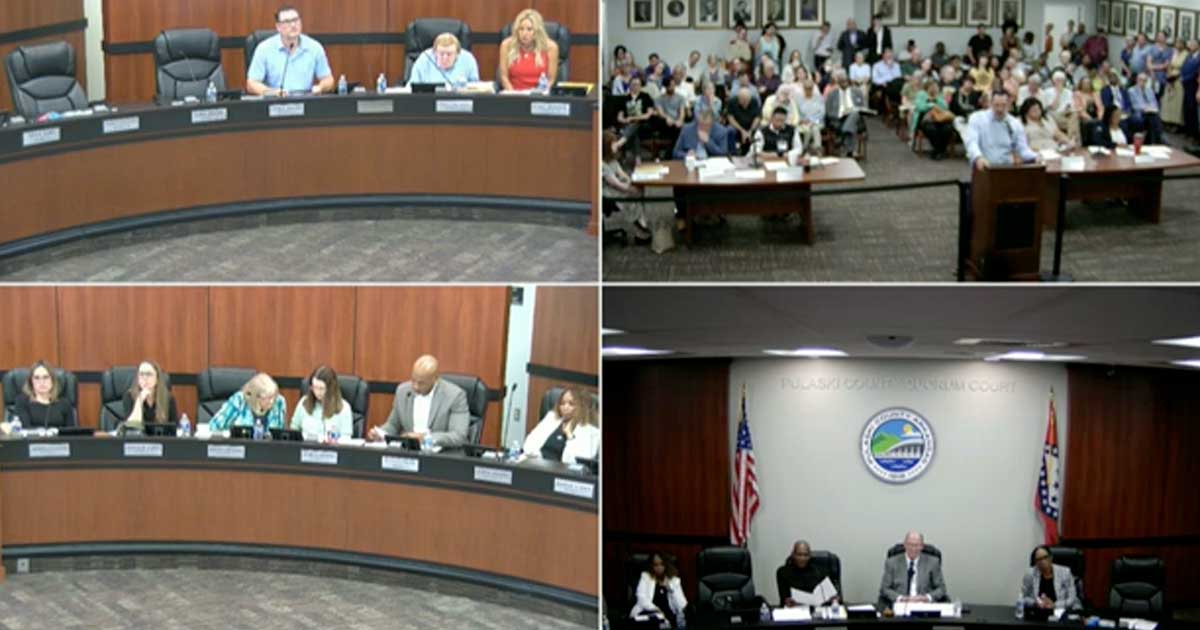
LITTLE ROCK, Ark. – The Pulaski County Quorum Court pulled back an emergency 90-day moratorium on data center projects Tuesday night after the county judge warned it would invite a lawsuit the county would lose, then advanced a sweeping ordinance regulating high-intensity digital infrastructure on the first of three readings.
The meeting drew a large crowd, most of it opposed to the AVAIO Digital data center campus under development near Wrightsville. More than a dozen residents spoke during public comment, and County Judge Barry Hyde admonished the audience several times to hold their reactions.
Moratorium dies on the floor
The moratorium, ordinance 26I-64, came to the court as a late filing just hours after the county planning board recommended it Tuesday afternoon. It would have paused acceptance, processing, review and approval of all new and existing applications for permits, zoning amendments and site plans for high-intensity digital infrastructure projects in the unincorporated county for 90 days.
Justice of the Peace Luke McCoy successfully amended the ordinance to raise its threshold from 5 megawatts to 10 megawatts, matching the definition in the companion regulatory ordinance. The amendment passed 8-3.
But the measure unraveled under questioning. McCoy pressed County Attorney Dominique Lane and planning board chair Mark Wilson on whether the moratorium would stay limited to data centers or sweep in other industries. Lane was elevated to the county attorney post this summer after her predecessor, Hamilton Kemp, resigned weeks after issuing his own warning against a data center moratorium.
Article continues below
▼ Continue reading
“If you’re asking me if I’m confident that it will limit to strictly data centers, the answer is no,” Wilson told the court.
Wilson said the board’s main request Tuesday was a 90-day extension to keep working on the regulatory ordinance, with the moratorium “added on as a placeholder to stop other projects from coming in.”
Hyde told justices the county’s attorneys had advised that halting an application already in process would subject the county to a suit it would likely lose.
“I don’t believe that you’re going to legally be able to make someone pause their construction process after they’ve already done everything we legally require,” Hyde said. “I’m afraid we’re gonna get in a lot of trouble and it’s gonna cost a lot of money.”
Justice Julie Blackwood then moved to withdraw the moratorium entirely, and the court agreed on a voice vote.
Pulaski County Public Works Director Tab Townsell, who has also been covering planning director duties since interim planning chief Jim Cranor resigned earlier this month, confirmed to the court that the existing data center project’s site plan conditions “have been satisfied.”
Regulation ordinance moves, but slowly
The court then took up ordinance 26I-56, which would classify high-intensity digital infrastructure uses as heavy industrial in the unincorporated county, require conditional use permits, and impose performance standards, cost recovery, inspection, monitoring, enforcement and decommissioning requirements.
Blackwood moved to strip the ordinance’s emergency clause, which would have made it effective immediately on passage. The court agreed without objection, placing the ordinance on its first reading instead. Under state law, ordinances without an emergency clause require three readings before final passage.
Blackwood told the audience during public comment that the timeline could move faster than the usual month-to-month cycle if the court reconvenes for additional readings.
“If we could gavel in again this month, then we could read it again, and then we could gavel in again and read it again and then we could pass it,” she said.
Griffen defends the ordinance, spars with House
Former circuit judge Wendell Griffen, who defeated Hyde in the March Democratic primary for county judge, spoke at public comment and said he wrote the ordinance’s fee provisions to fit existing case law. He cited Arkansas Supreme Court rulings upholding regulatory fees, including City of Marion v. Baioni from 1993 and a 2011 stormwater fee case, along with the U.S. Supreme Court’s 1989 Sperry decision.
“When the law says when you bring your suit, you’re gonna lose, don’t say I’m scared of being sued,” Griffen said.
Griffen was responding to attorney Doug House, who was introduced Tuesday as the court’s expected newest member for the vacant District 13 seat, though House told the crowd his appointment was not yet in writing. The court declared the District 13 seat, previously held by Republican Phil Stowers, vacant at its June 23 meeting. House warned that imposing new requirements on an already approved permit would open the county to what he called a massive lawsuit, and estimated the completed data center would generate roughly $8.4 million a year in school property taxes.
House also told the court he had heard secondhand that the U.S. Army Corps of Engineers issued the project’s remaining permit last week, and urged justices to verify it. Other speakers, including attorney and Sierra Club of Arkansas chair George Wise and retired law professor Lynn Foster, argued AVAIO has no vested rights under Arkansas case law because construction had not substantially begun before new restrictions were proposed.
District 10 vote resolution fails without a single yes
A late-filed resolution from Justice Dianne Curry urging certification of “all lawfully cast votes” in the March 3 Democratic primary for Justice of the Peace District 10 failed 0-10, with two justices voting present.
Lane told the court that a Feb. 2 order from the 11th Division of Pulaski County Circuit Court barred the county election commission from counting votes cast for a candidate ruled ineligible to hold office in Arkansas. The candidate’s name appeared on ballots because the order came after provisional ballots had already been mailed, Lane said.
The case is on appeal to the Arkansas Supreme Court, which declined expedited review, and no stay is in place, Lane said.
Curry, who represents a different district, said the resolution was “an expression from the people that voted in those elections” who want to know the vote totals. After hearing the county attorney’s explanation, Curry voted no on her own resolution.
Justice Tina Ward questioned why Curry brought a resolution about a district represented by Justice Patricia Young-Baker, who was absent Tuesday.
Jacksonville ward resolution passes after trimming
The court voted 9-4 to acknowledge a Jacksonville ballot initiative that will let city voters decide whether to replace the city council’s at-large voting system with wards, but only after stripping two whereas clauses that some justices said read like an endorsement.
Hyde told the court Jacksonville’s mayor had called and asked the county not to approve the resolution. Justice Aaron Robinson, a Jacksonville resident, objected that the original language claimed citizens “desire” the change when no vote has occurred, and noted the Jacksonville City Council voted against ward-based representation.
Lane said the resolution was a legal acknowledgment that initiative organizers followed proper procedure, not a statement of support. Justice Rebekah Davis’s amendment removing the disputed language passed 13-0 before the final vote. The resolution was sponsored by Young-Baker.
Other business
County Comptroller Michael “Hutch” Hutchens delivered the 2024 legislative audit, which he said contained no findings. Hutchens pushed back on an email justices received earlier Tuesday from the county treasurer’s office, saying claims made in April that he and the county judge moved money inappropriately were “completely incorrect” because legislative audit reviews every ordinance and reconciles transfers.
The court also unanimously:
Confirmed the appointments of Keith Cook and Gerald Tucker and the reappointment of Doug Darr to the Runyan Acres Fire Protection District No. 10 board.
Confirmed Luis Calderon, a bilingual commercial lender with First Security Bank, to the Multipurpose Civic Center Facilities Board.
Authorized a county application to the Arkansas Economic Development Commission for a community assistance grant.
Accepted drug court foundation grant funds for the 11th Division Circuit Court.
Approved a resolution allowing William Wesley Walker to solemnize a Sept. 19 wedding in the county.
The Quorum Court’s next regular meeting is Sept. 8.
Get the biggest Arkansas stories in your inbox
Breaking news, arrests and court updates from across the state. Free.
Confirmation email required. Powered by Mailchimp.