Nearly 1,000 automated license plate readers have been reported across Arkansas, quietly photographing every vehicle that passes — and the cameras are increasingly at the center of legal threats, wrongful traffic stops and public pushback from Texarkana to Cleburne County.
The crowdsourced DeFlock mapping project counts at least 943 license plate readers statewide as of July, ranking Arkansas the 28th most-surveilled state in the country by camera count. Volunteers have mapped cameras in 102 Arkansas cities and 45 counties, with the heaviest concentrations in Conway, Jonesboro and Little Rock.
The true number is likely higher. The Little Rock Police Department alone disclosed 116 cameras in response to a state Freedom of Information Act request reported by the Arkansas Times earlier this year, nearly double what volunteers had mapped in the city. The Electronic Frontier Foundation’s Atlas of Surveillance has documented Flock Safety systems in use by roughly 40 Arkansas law enforcement agencies, including police departments in North Little Rock, Sherwood, Jacksonville, Conway, Alexander and Texarkana.
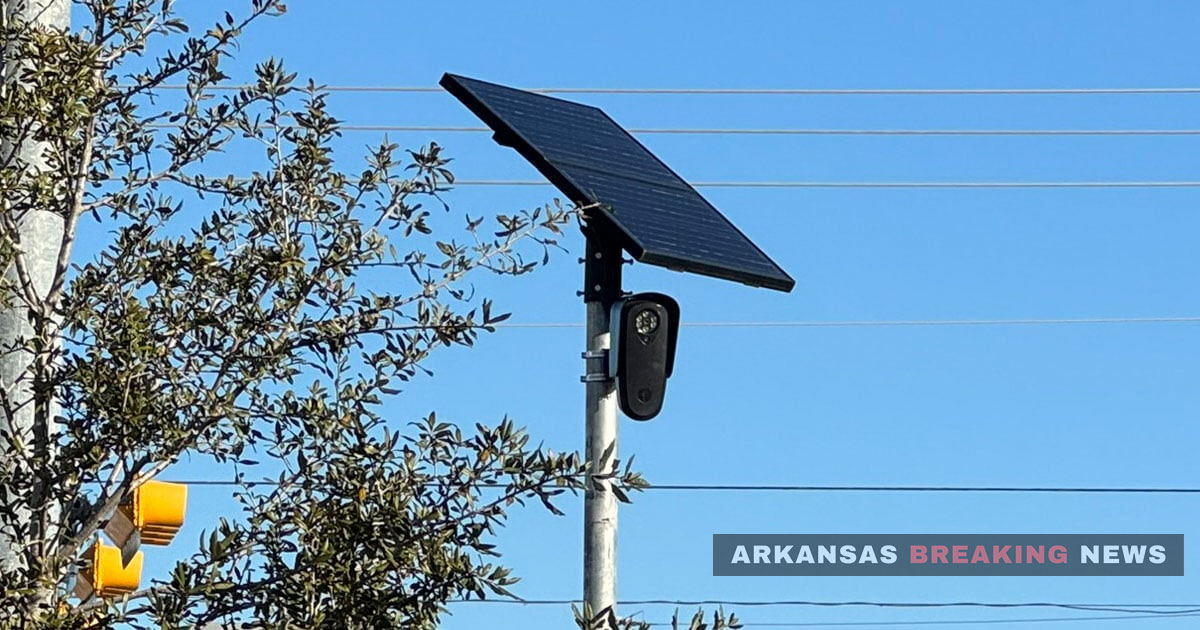
Flock Safety, the Atlanta-based company that dominates the market, says its network now spans more than 5,000 communities nationwide and conducts more than 20 billion license plate reads per month. The fixed cameras, typically mounted on poles along busy roads, capture more than plates: date, time, location, and a vehicle’s make, model, color and distinguishing features such as bumper stickers and dents.
What Arkansas law says
Arkansas regulates the technology under the Automatic License Plate Reader System Act, codified at Arkansas Code § 12-12-1801 and following sections, which restricts the systems to law enforcement purposes and limits how captured data may be kept and shared.
The Legislature expanded the law in 2025. Senate Bill 446, sponsored by Sen. Ben Gilmore, R-Crossett, passed the Senate 32-0 and was signed by Gov. Sarah Huckabee Sanders in April 2025. The law authorizes private landowners, leaseholders and commercial businesses to operate license plate readers on their property for the first time, on the condition that the data is deleted after 60 days. Law enforcement access to privately collected images is tied to investigations and legal process, including subpoenas. State agencies and parking enforcement may store plate data for up to 150 days, according to Stateline. (Full bill text here.)
Stateline grouped Arkansas with Idaho and Montana as conservative-led states that enacted laws in 2025 designed to protect personal data collected through license plate readers, part of a national wave of concern that has crossed party lines.
The Arkansas State Police has also proposed administrative rules governing its own use of the readers, restricting the systems to legitimate law enforcement purposes, requiring officers to verify an alert before initiating a traffic stop, and requiring dissemination logs when data is shared with other agencies.
The Greers Ferry fight
The state’s highest-profile legal confrontation came in Greers Ferry, a small Cleburne County town that contracted with Flock in September 2024 to install five cameras.
One of them ended up outside city limits on Lone Pine Road South, directly across the street from the home of Charlie and Angie Wolf, a retired police officer and teacher. The camera photographed their driveway and front yard every time a vehicle passed, logging their comings and goings. When Charlie Wolf asked the police chief to move it, he was told, “It’s not moving.” The city attorney later suggested he get a court order.
In July 2025, the Institute for Justice, a national public-interest law firm, sent the city a demand letter arguing the camera amounted to warrantless, around-the-clock surveillance in violation of the Fourth Amendment. The firm cited the U.S. Supreme Court’s Carpenter v. United States decision and a pending federal lawsuit over Norfolk, Virginia’s Flock network, where a judge had allowed a constitutional challenge to proceed.
Within days, and under pressure from the Cleburne County Quorum Court, as KATV reported, Greers Ferry agreed to move the camera inside city limits and asked Flock to disable it. The dispute never reached a courtroom, but Institute for Justice attorneys said “massive Fourth Amendment concerns” remain with the technology statewide and urged the city not to renew its contract.
A gunpoint stop over one letter
In February, a Flock camera in Sherwood misread a license plate by a single character — registering an “X” as a “Y” because a license plate frame partially covered the tag — and flagged a black Chevrolet Tahoe as stolen. An officer pulled the vehicle over in a Kohl’s parking lot and drew his weapon. A couple was detained while their 1-month-old child sat in the back seat, according to KATV and the Arkansas Democrat-Gazette.
The Institute for Justice, which tracks wrongful stops tied to plate reader errors, has documented at least 26 such cases nationally since 2018, most of them since 2023. Flock says its cameras accurately capture about 93 of every 100 plates, a rate that, at 20 billion monthly reads, still implies more than a billion misreads per month.
After the Sherwood incident, the police department launched a public transparency portal showing the city operates roughly 15 cameras, retains data for 30 days, requires a valid reason for every search, and prohibits use of the data for immigration enforcement, traffic enforcement, harassment or intimidation. Sherwood’s cameras have read 29 million plates since the beginning of 2026, according to the department.
What police say the cameras deliver
Arkansas law enforcement agencies point to a growing list of cases the cameras helped close.
The most dramatic came in July 2025, when a Flock camera on South Main Street in Searcy picked up a rental car tied to a double homicide in DeKalb, Texas, in Bowie County near the Arkansas line. A White County sheriff’s deputy stopped the vehicle, and the suspect, who was carrying weapons and the victims’ identification cards, confessed to the killings, the Arkansas Democrat-Gazette reported. Searcy police said they had no idea the car was connected to a homicide when the camera flagged it. In a separate case, Harrison authorities captured a Georgia attempted murder suspect after his car hit on a Flock camera.
Sherwood police say their cameras have helped locate five missing people, recover seven stolen vehicles and identify 25 wanted individuals since 2022, including juveniles and elderly residents with dementia. “It gives us a way to give someone back to their families,” Capt. Scott Hicks told KATV. The department’s relationship with Flock began after a 2020 double homicide, when Sherwood investigators had to borrow another agency’s plate reader data to work the case.
Conway police cited their own examples in defending the system this spring: a missing juvenile found in Missouri within hours of the vehicle information being loaded into Flock in September 2025, and two stolen vehicles recovered this March, one in about 11 minutes and another in 8 minutes after alerts came in.
Flock itself claims its cameras help solve about 2,500 crimes per week nationally, more than 10% of reported crime in the U.S., a company spokesperson told the Democrat-Gazette. Independent audits elsewhere have been less flattering: a review of Austin’s program found 75 million scans produced 165 arrests and 133 prosecutions before that city ended its contract.
Pushback, but no cancellations yet
No Arkansas city has canceled a Flock contract, even as roughly 50 cities nationwide, including Denver, Austin and Dayton, Ohio, have terminated or declined to renew agreements, many after audits revealed federal agencies or out-of-state departments searching local data, in some cases for immigration enforcement.
But the pressure is arriving in Arkansas:
In Texarkana, residents urged the City Council this month to disable the city’s Flock cameras and suspend its contract, citing privacy risks, security vulnerabilities and the national cancellation wave. City officials have not announced any change. On the Arkansas side of the state line, the Texarkana, Arkansas Police Department operates eight cameras.
In Little Rock, the Board of Directors extended the city’s Flock contract in October 2025 for two years at a cost of $690,000. Then in December, the board rejected a transparency ordinance proposed by At-Large Director Antwan Phillips that would have codified public reporting requirements for the police department’s surveillance technology. The police chief spoke against the measure, the Arkansas Times reported.
In Conway, the most heavily mapped city in the state with more than 100 cameras reported countywide, the police department issued a public statement in April to dispel rumors, saying it operates 19 fixed plate readers at eight intersections, does not use Flock’s live-video products, and does not use the system for traffic enforcement.
Data sharing remains the least visible piece. Reporting by the Arkansas Times found nine Arkansas law enforcement agencies sharing plate data from hundreds of cameras with a sheriff’s department in Texas hundreds of miles away, a reminder that when an Arkansas agency opts into Flock’s national network, plates scanned on Arkansas roads can be searched by thousands of outside agencies.
For now, the cameras keep multiplying. Volunteers reported 118 newly mapped license plate readers in Arkansas in the past 30 days alone.