FAYETTEVILLE, ARK. — A former University of Arkansas program director accused of using public money to pay for his wedding reception and honeymoon has formally denied the university’s fraud claims, setting up a federal court fight over nearly $50,000 in disputed research travel.
Dr. Najja K. Baptist, a tenured associate professor of political science and former director of the university’s African and African American Studies program, filed his answer to the university’s counterclaims June 18 in the Western District of Arkansas. He denies committing fraud, converting public funds or breaching any fiduciary duty, and argues the university’s countersuit is itself retaliation for his discrimination complaints.
The filing is the latest turn in a case that began with dueling accusations. Baptist sued the university, its board of trustees and four administrators April 13, alleging race discrimination, retaliation and due process violations after Fulbright College Dean Brian Raines recommended his firing. The university answered May 7 with counterclaims of its own, accusing Baptist of fraud, conversion of public funds, unjust enrichment and breach of the fiduciary duty of public trust.
The wedding at the center of the case
The university’s case centers on June 7, 2025, the day Baptist married in Columbia, South Carolina.
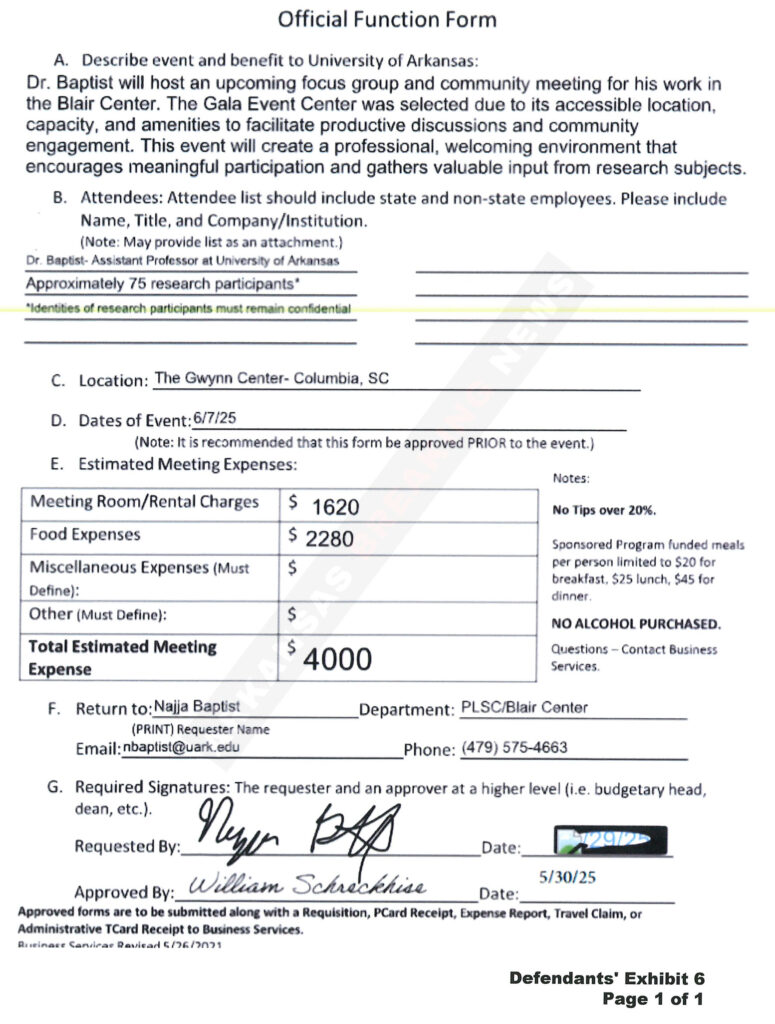
According to the university’s court filing, Baptist asked a university staffer in May 2025 to fill out an official function form describing a “focus group and community meeting” for approximately 75 research participants at the Gala Event Center in Columbia. The form listed the event date as June 7, 2025, with an estimated $4,000 in room rental and food expenses. Baptist signed the form, and his department chair approved it.
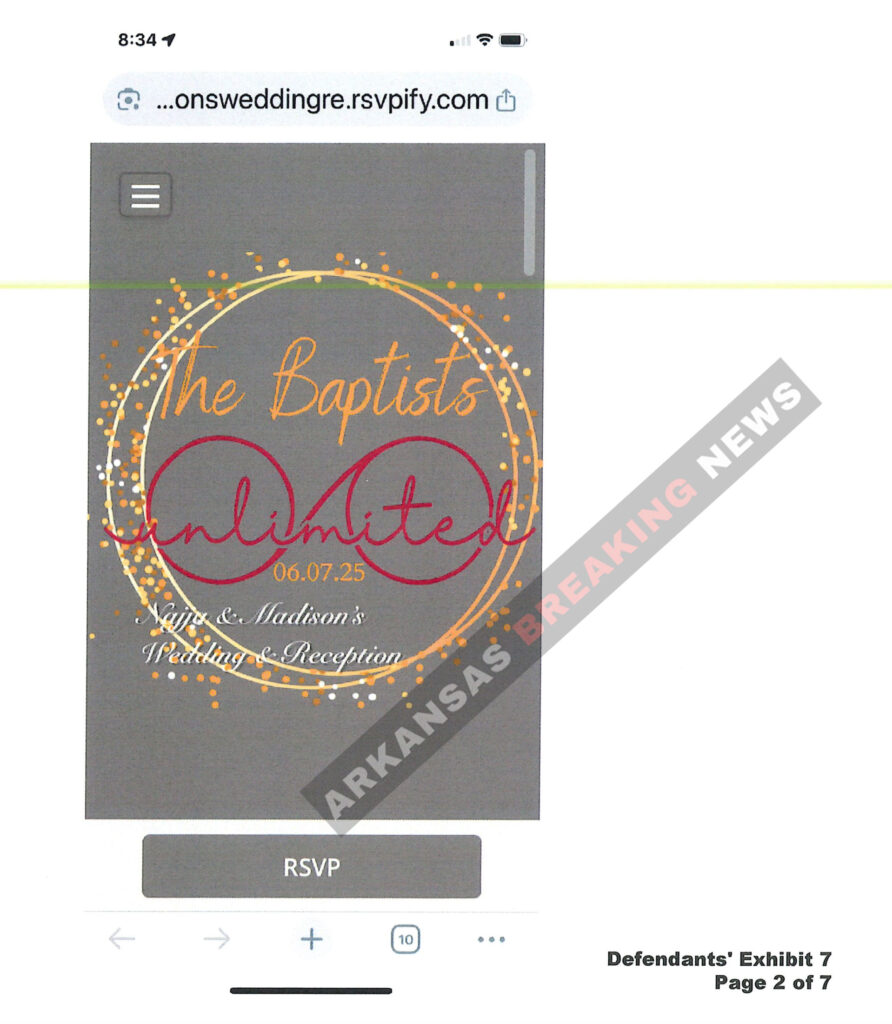
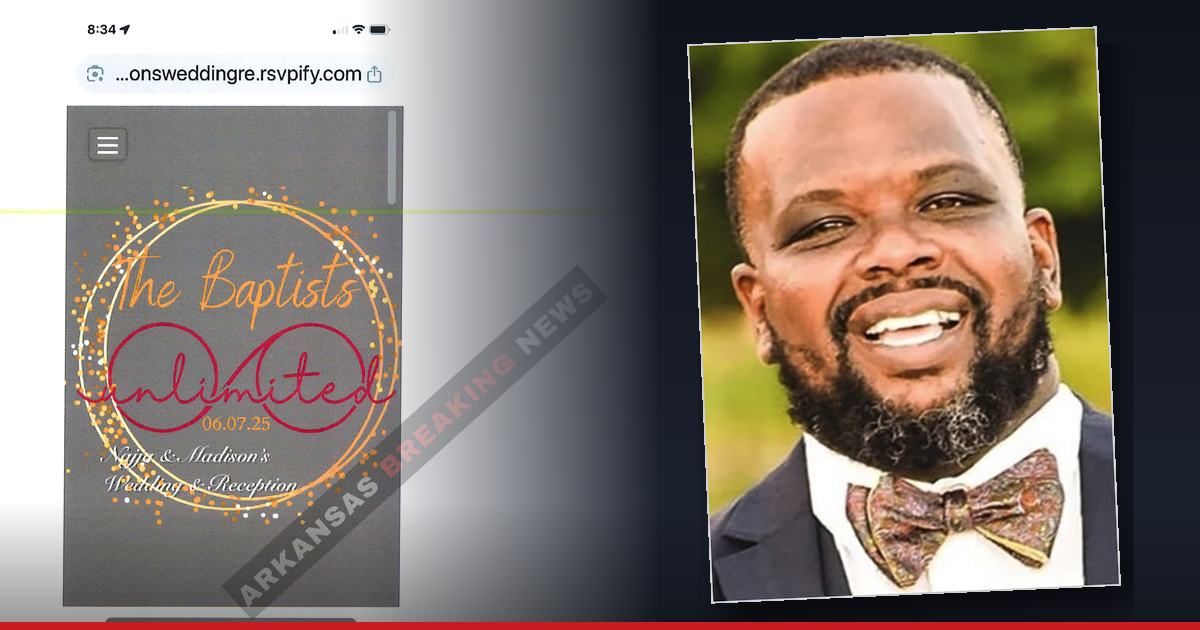
The university says the same venue, on the same afternoon, hosted Baptist’s private wedding dinner reception. A wedding invitation Baptist texted to his department chair listed a reception at the Gala Event Center at 3:30 p.m. on June 7, according to the filing. The invitation asked guests for monetary donations toward the couple’s honeymoon in lieu of gifts.
The filing also cites a review Baptist posted on VRBO after a June 7-10 stay at a Pawleys Island, South Carolina, rental. In the review, Baptist thanked the host for a stay he described as spectacular for newlyweds, according to the court document. Days before the trip, the university says, Baptist told colleagues by email he would be unavailable because of his wedding and honeymoon.
The university alleges Baptist used $11,229.02 in university funds on the wedding reception and honeymoon. A system internal audit completed in March identified $48,344.26 in total apparent losses across roughly 15 trips between September 2024 and July 2025, including travel to Augusta, Charlotte, New Orleans, Memphis, Miami and Washington, D.C. Some of the money came from National Science Foundation grant funds and private endowments, according to the filing.
What Baptist admits and what he disputes
In his June 18 answer, Baptist admits much of the paper trail. He acknowledges requesting the university travel card, signing the official function form, booking the Pawleys Island rental and posting the VRBO review. He admits the Gala Event Center is in Columbia and that the wedding invitation says what the university quotes it as saying.
What he denies is what it all means. Baptist’s answer repeatedly asserts that none of the documents establish the expenses were personal, unauthorized or fraudulent. In responding to the wedding invitation, his answer denies “any implication that the invitation accurately describes all uses, purposes, or activities associated with the Gala Event Center on June 7, 2025.”
Baptist flatly denies the $11,229.02 figure. He also disputes an internal audit finding about a June 10, 2025, dinner receipt. The university says the receipt showed two guests, that Baptist claimed he dined alone and ate all the food, and that a waitress at the restaurant told auditors he dined with a female guest. Baptist denies that auditors confirmed any of that.
His answer raises 13 affirmative defenses. Chief among them: every expense went through university processes and was reviewed and approved by university personnel before payment. He also argues the university cannot treat what his filing calls a disputed, inference-driven audit amount as an established debt without due process, and that the counterclaims were brought for retaliatory and pretextual reasons.
Allegations of fabricated research records
The university’s May filing contains allegations that go beyond expense disputes.
In December 2025, Baptist’s attorney submitted 108 Word documents to the UA System’s internal audit director, represented as anonymized records of the focus group research. The university says the documents contain what it calls numerous anomalies, including metadata indicating batch creation, unusually formal language lacking filler words and contractions, mixed British and American spellings, and data collection dates falling on major holidays.
According to the filing, records of the purported Gala Center session show participants at nearly every table answering questions in the same order with nearly identical responses. One set of purported focus group transcripts was dated during a period when Baptist had evacuated Augusta, Georgia, because of a hurricane, the university says.
The university contends the documents were constructed from two pages of handwritten notes and Baptist’s recollections. When Raines confronted Baptist with the findings, Baptist said he stood behind the data but offered no further explanation, according to the filing.
Baptist’s June answer does not address the 108 documents directly. The fabrication allegations appear in the university’s answer to his complaint rather than in the counterclaim paragraphs he was required to answer.
Discrimination complaint preceded the audit
Baptist, who is Black, alleges the scrutiny of his travel came only after he complained about a remark Raines made during a virtual meeting in January 2025. A University of Maryland researcher who overheard part of the call told university investigators he recalled Raines saying something like “This is why people can’t be trusted with leadership,” according to court records. Baptist alleges the comment reflected a view that Black faculty could not handle stress.
The university denies Raines made any discriminatory statement. According to its filing, Raines told Baptist that people in college leadership must manage stressful situations well and be the calmest people in the room. The university’s Office of Equal Opportunity, Compliance and Title IX investigated and concluded in October 2025 that Baptist’s discrimination and retaliation claims were unfounded.
The university also notes Raines recommended Baptist for tenure in December 2024 and appointed him to an endowed chair in March 2025, months before the expense review began.
Baptist filed an EEOC charge in late 2025 and received a right-to-sue notice in January. Raines recommended his dismissal March 12, citing theft, misuse of property, dishonesty and unethical conduct. Chancellor Charles Robinson agreed and initiated formal dismissal proceedings. Baptist was removed as program director the same month.
Baptist’s attorney, JJ Thompson Sr. of Cave Springs, also represents Shirin Saeidi, the former director of the university’s King Fahd Center for Middle East Studies, whose December 2025 dismissal drew academic freedom concerns. The American Political Science Association has raised questions about due process and academic freedom in Baptist’s case.
Both sides have demanded jury trials. The case is before the U.S. District Court for the Western District of Arkansas, Fayetteville Division, Case No. 5:26-cv-05077.