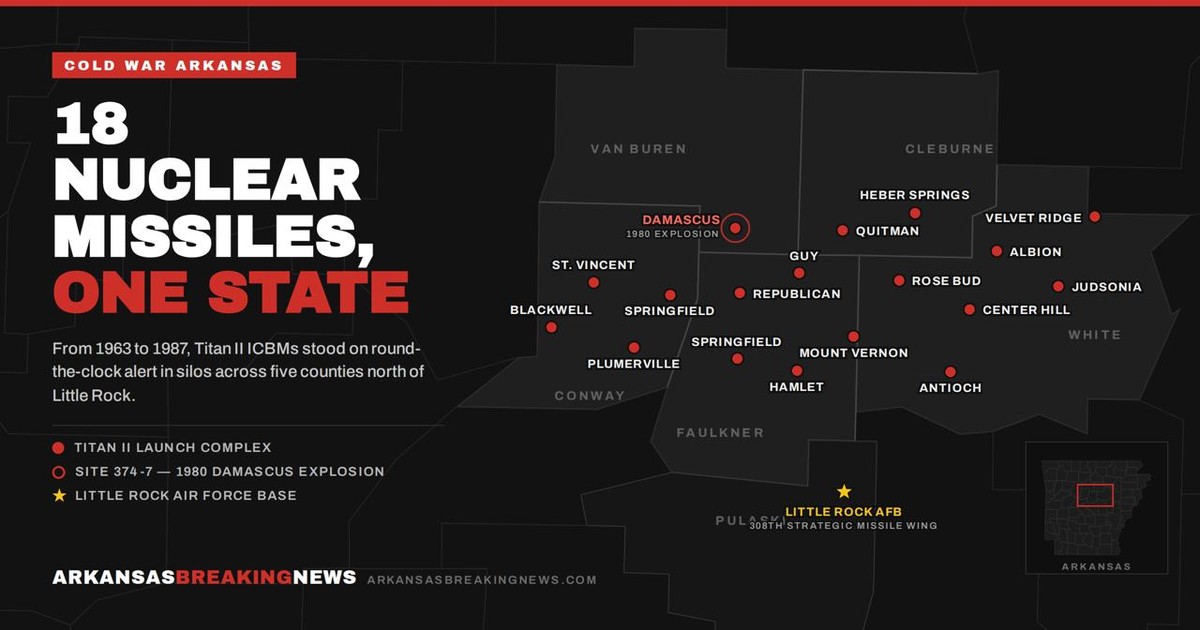
Did you know that for 24 years, Arkansas was one of the most heavily armed places on Earth? Then, almost overnight, it wasn’t.
In 1960, the Air Force announced that Little Rock Air Force Base would host 18 Titan II intercontinental ballistic missiles. Crews blasted silos 150 feet into the bedrock of Faulkner, Conway, Van Buren, Cleburne and White counties, and by the end of 1963, all 18 missiles of the 308th Strategic Missile Wing stood on 24-hour alert near towns like Damascus, Quitman, Guy, Plumerville, Judsonia and Heber Springs.
Each Titan II carried a single 9-megaton W-53 warhead — the most powerful ever placed on an American missile. One warhead held three times the explosive force of every bomb dropped in World War II. Arkansas had eighteen of them. Four-man crews sat underground around the clock, ready to launch in under a minute.
The price was steep. In 1965, a fire during modifications at the silo near Pangburn killed 53 workers, making it one of the deadliest disasters in Arkansas history. In 1980, a dropped wrench socket at the Damascus site punctured a fuel tank. Hours later the missile exploded, hurling the 740-ton silo door 600 feet and ejecting the warhead. Senior Airman David Livingston was killed. The warhead never detonated.
A year after Damascus, President Reagan announced the Titan II’s retirement. The missiles were aging, dangerous to maintain, and obsolete. Newer Minuteman missiles were far more accurate and carried multiple smaller warheads, ending the need for one giant one. Arkansas’s last missile came off alert in 1987. The silos were dynamited, and the craters were deliberately left open for months so Soviet satellites could confirm they were destroyed. Then they were filled in and seeded with grass.
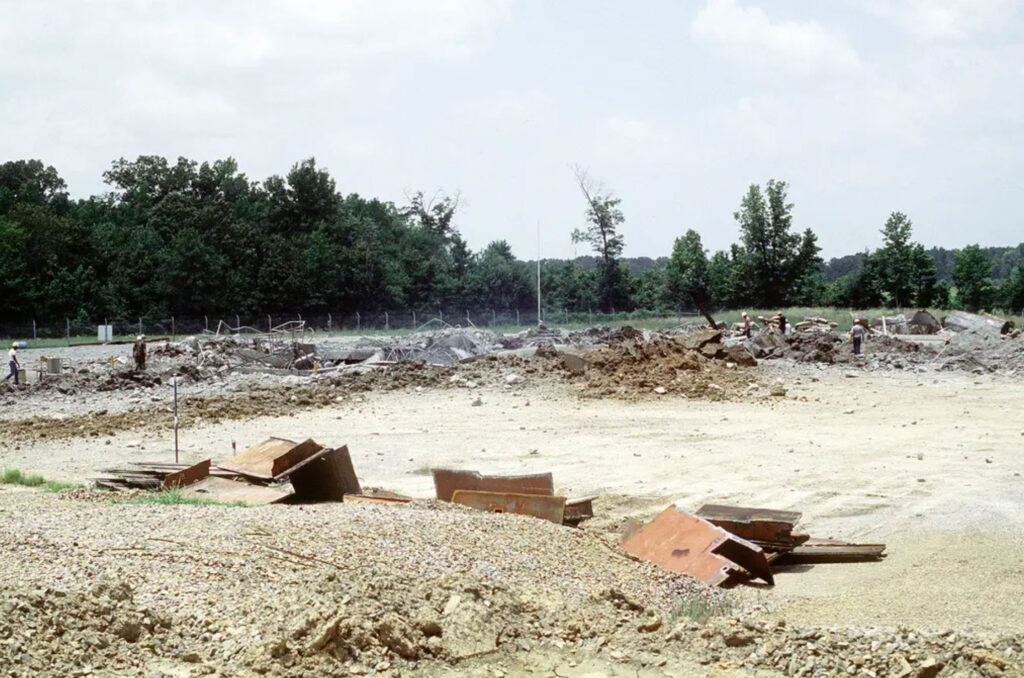
The Minuteman fields that replaced the Titan II were built in Montana, the Dakotas and Wyoming — closer to the polar flight paths and with room to scatter hundreds of silos. No new missiles ever came to Arkansas. Little Rock AFB turned to the C-130 mission it still flies today.
The 308th deactivated on August 18, 1987. Arkansas left the nuclear age the way it entered it: quietly, with most neighbors never knowing what was buried down the road.
Get the biggest Arkansas stories in your inbox
Breaking news, arrests and court updates from across the state. Free.
Confirmation email required. Powered by Mailchimp.