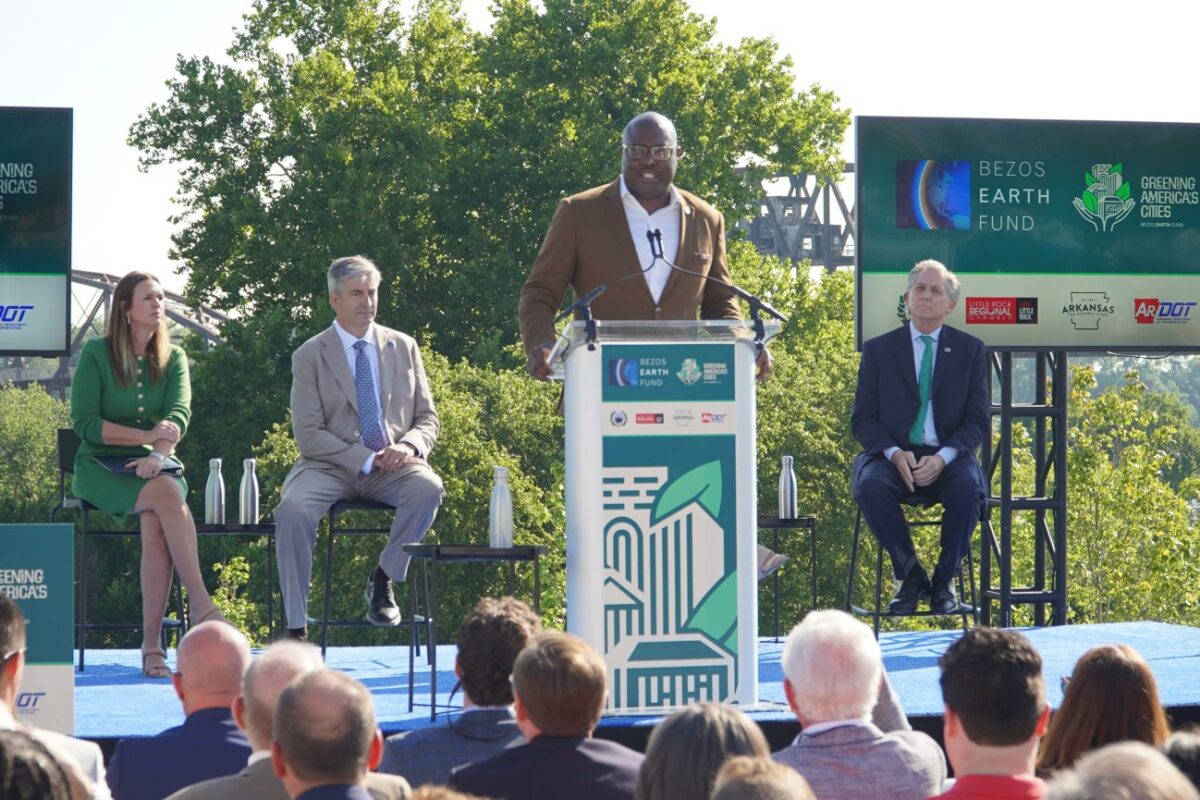
LITTLE ROCK — Little Rock has landed a $30 million grant from the Bezos Earth Fund to help build 30 Crossing Park, a planned green space that would knit downtown back together with the Arkansas River. City and state leaders unveiled the award Tuesday at a news conference near the Clinton Presidential Center, calling it a once-in-a-generation chance to remake the capital’s riverfront.
The money is the single largest share of a $100 million round the fund is distributing to eight cities through its Greening America’s Cities initiative, which turns vacant or underused urban land into parks and wildlife habitat. Little Rock outdrew the other recipients — Allentown, Pennsylvania; Atlanta; Cleveland; Indianapolis; Los Angeles; Salt Lake City; and Sioux Falls, South Dakota. It is the program’s second round; the fund says it has now committed about $150 million across 11 cities on the way to a planned $400 million nationwide.
Bezos Earth Fund President and CEO Tom Taylor joined Gov. Sarah Huckabee Sanders, Little Rock Mayor Frank Scott Jr., U.S. Rep. French Hill and Little Rock Regional Chamber Chair Ruth Whitney for the announcement. “This $30 million, transformational investment by the Bezos Earth Fund will reconnect land, neighborhoods, trails, cultural destinations and people in a way that reflects who we are as Arkansas’ capital city,” Scott said. Taylor framed the fund’s role more modestly: “We look at our role in helping to catalyze and exemplify what can be done, to show what’s possible and help bring it to life.”
A park built on a highway’s leftovers
The most striking thing about 30 Crossing Park is where it comes from. The roughly 18-acre site — which officials often round up to 20 — exists only because the Arkansas Department of Transportation tore out the old Highway 10 and Cantrell Road cloverleaf interchange as part of its 30 Crossing project, the reconstruction and widening of Interstate 30 and its bridge over the Arkansas River between Little Rock and North Little Rock.
That highway work was the most expensive project ARDOT has ever undertaken, with a first phase that ran about $634 million and was substantially finished in late 2024. It was also contested. Opponents sued in 2020, arguing the widening violated a state constitutional amendment barring the half-cent transportation tax from funding highways of more than four lanes; a trial court initially sided with the plaintiffs before the Arkansas Supreme Court reversed that ruling in 2023. Critics also questioned the logic of expanding a freeway through the center of downtown at a moment when other American cities were tearing theirs out. The park is, in effect, an attempt to reclaim a sliver of that footprint — turning off-ramps and concrete back into public green space.
What the plan calls for
The design, by the firm Sasaki, was finalized as a master plan in late 2025 and is roughly a third complete. Renderings show a destination playground of interconnected towers inspired by the fire lookouts of the Ouachita Mountains, a riverfront boardwalk with a restaurant and boathouse where paddlers could launch kayaks, and a shaded zone tucked beneath the highway overpass with a skate park, rock climbing and basketball and other sport courts. Near the Clinton Center, the plan envisions a flexible lawn and a small amphitheater; the lowest ground would double as stormwater drainage and a wetlands-education area. A cultural trail would link the park’s core to the Main Library and the Historic Arkansas Museum, and planners say the site would ultimately connect more than 100 acres of riverfront green space, including the existing Riverfront Park.
A down payment, not the full bill
For all the fanfare, the $30 million is a starting point. Sasaki’s December 2025 estimate put the total buildout at $93 million to $128 million, depending on how quickly the work is done and where material prices land; Scott has offered a rougher figure of about $85 million. The grant is earmarked for the initial design phase, expected to cost $5 million to $9 million and take 12 to 18 months, with the first visible landscaping to follow.
The fund itself describes the award as “positioned to catalyze” another $60 million to $70 million in fundraising — which means the bulk of the money is not yet in hand. Scott said the city will pursue federal U.S. Department of Transportation grants and will detail a private fundraising campaign later. “I’m pretty certain that we’re not bringing Jeff Bezos here and not getting it done,” he said. Kyle Leyenberger, executive director of the Downtown Little Rock Partnership, said the goal is to have key areas across the park’s four quadrants “substantially completed in three years,” adding, “It’s going to be a push to get it done.”
How Little Rock got the money
By the city’s own account, the grant was as much salesmanship as serendipity. Leyenberger said the fund reached out to U.S. Sen. John Boozman’s office looking for a project to back in Arkansas, and Little Rock surfaced just as it released its park master plan. “Our plan aligned with their goals and the kind of things they want to see happen,” he said. Scott said he treated the opportunity as an economic-development pitch, walking the fund’s representatives through several sites; when one floated a $15 million figure, the mayor asked for $30 million instead.
Chamber leaders leaned hard into that framing. Whitney called 30 Crossing Park “not just a parks and rec project” but “a flagship economic development project,” arguing that site selectors and tech firms weigh a city’s livability. “We are sending a clear message to the world: Little Rock is actively building a dynamic, inclusive urban environment that the modern workforce demands,” she said. Notably, the deal drew a bipartisan cast — a Democratic mayor alongside Republican state and federal officials — around philanthropy from one of the country’s wealthiest families landing in a solidly red state.
The fund behind the grant
The Bezos Earth Fund was launched in 2020, when Amazon founder Jeff Bezos pledged $10 billion to environmental causes. It is led by Taylor and chaired by Bezos, with his wife, Lauren Sánchez Bezos, serving as vice chair. Its portfolio ranges widely — from wildfire-detection satellites to research on sustainable materials — and the Greening America’s Cities program is its community-facing, urban slice. “That’s what a great park does,” Sánchez Bezos said in a statement tied to the announcement, recalling a childhood park in Albuquerque. “It makes the world feel bigger and the world feel safer.”
For Little Rock, the test now is whether a high-profile down payment can pull in the tens of millions still needed — and whether a park stitched from a highway’s remnants can deliver the riverfront transformation its backers are promising. Residents should see the first design work within a year, officials say, and “significant” construction inside two.
Get the biggest Arkansas stories in your inbox
Breaking news, arrests and court updates from across the state. Free.
Confirmation email required. Powered by Mailchimp.