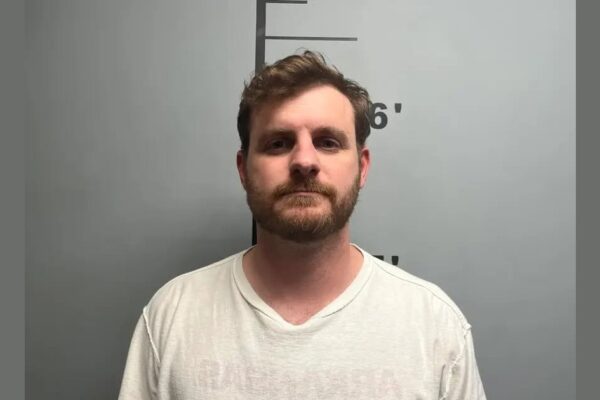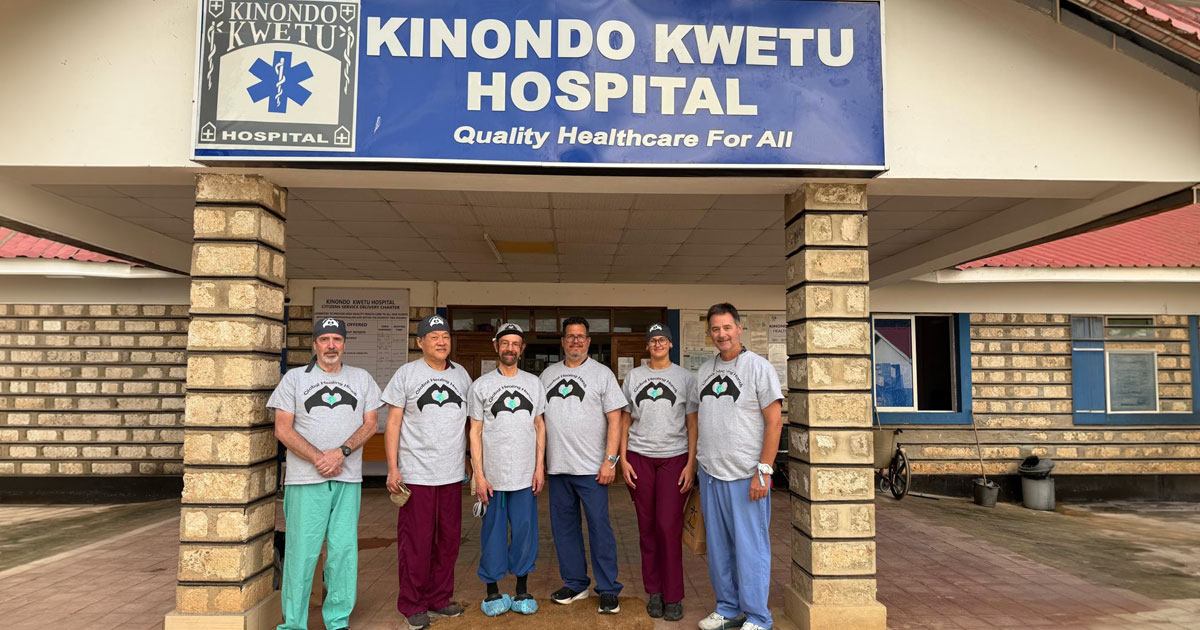
A cardiac anesthesiologist at Arkansas Heart Hospital just got back from Kenya, where he spent his days keeping patients alive on the table while surgeons removed thyroid growths big enough to press on their airways.
Dr. Thomas Hunley has been an anesthesiologist for 33 years. At the heart hospital in Little Rock he works mainly in cardiac anesthesia, which means heart bypass operations, open valve replacements and endovascular valve procedures. He came to Little Rock after 21 years in Texarkana, a stretch in Hot Springs and about five years in Longview.
The Kenya trip was his seventh to East Africa. He has been to Rwanda five times and Madagascar once. Kenya was new.
He goes with Global Healing Hands, a nonprofit run by Dr. Fletcher Starnes, an endocrine surgeon. The rest of the team is mostly surgeons, nurses and nurse anesthetists out of Albany, New York. The main sponsor of the trips is Medical Missions for Children, a Massachusetts-based nonprofit that sends volunteer surgical teams to remote parts of the developing world. Starnes practices general and endocrine surgery in the Albany area.
Why goiters
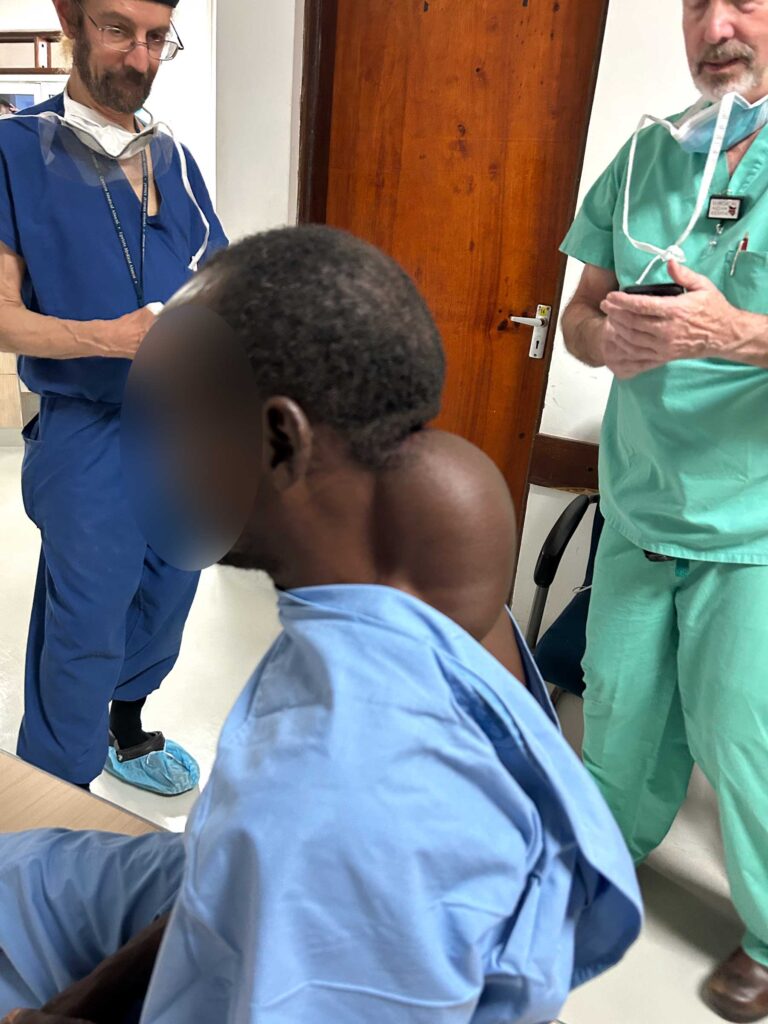
The team focuses almost entirely on one condition: giant goiters.
A goiter is an enlarged thyroid gland. Hunley described it as a gland that hypertrophies, growing out of control. The most common cause worldwide is iodine deficiency. Without enough iodine, the thyroid grows larger trying to capture what little is available.
The United States solved this problem largely by iodizing table salt.
“If anybody out there that’s older can remember, a lot of older people can remember somebody’s grandmother or uncle or aunt that had a goiter,” Hunley said. “Because we didn’t always have iodized salt. It wasn’t readily available.”
In parts of East Africa, he said, sea salt is the predominant form of salt, and it is not iodized. Cereals and breads are not fortified either.
The result is goiters that grow for years untreated. Hunley said you rarely see them in the United States anymore because thyroid nodules get caught and treated long before they reach that size.
A curse, not a diagnosis
The part of the story Hunley wanted people to understand has nothing to do with medicine.
In the communities the team visits, a large goiter is often understood as a curse.
“They think it’s a curse,” Hunley said. “They did something bad, or somebody put a spell on them.”
Patients go to traditional healers first. Hunley said he kept noticing markings on the skin over the mass and could not figure out what they were.
“I was always curious, what is that? Did somebody operate on them?” he said. “No, that’s a voodoo doctor. Did some scar and some burnt offerings.”
The carvings look almost like tattoos over the growth. They are attempts to drive the curse out.
Patients with visible goiters are pushed to the margins of their communities, Hunley said. They keep the mass covered. Young women in particular have a hard time finding a husband, because men in the community believe the goiter is evidence of a hex or bad karma.
How the work happens
Local physicians identify patients ahead of time and coordinate with Starnes. By the time the American team lands, 20 or 30 people are already waiting.
The team usually operates three to four days, sunup to sundown. Hunley said they can get through four to seven giant goiters a day, which he called a pretty good clip. A second operating room typically runs at the same time doing hernia repairs, and the team may complete 30 or 40 of those.
Conditions vary widely, and Hunley was blunt about the limits.
“You cannot impose American standards on these developing countries’ health care system,” he said. Equipment gets reused. A lot of it is broken. The team fixes what it can, brings what it can, leaves behind what it can, and tries to pass along knowledge that outlasts the visit.
Anesthesia is the hard part. These are large masses sitting directly over the airway, and the risk is that the airway collapses under the weight during induction.
Blood exposure is a constant concern. Some patients know their HIV status and disclose it. Others do not know. Hunley said the team uses strict precautions starting IVs and throughout every case because it operates without the testing an American hospital would have on hand.
The singer
Asked whether any case stuck with him, Hunley went back to a trip to Rwanda.
A woman in her mid-20s came in with a large goiter. She was a singer, and she was terrified the surgery would take her voice.
Her fear was medically sound. The nerve that controls the vocal cord runs directly through the area where the goiter sits.
The surgeon worked carefully to identify and protect the nerve. The operation went clean and the scar healed well.
“She was so happy and crying,” Hunley said. “That was pretty satisfying, that we helped her.”
What happens after the team leaves
Patients need their thyroid levels checked two or three weeks after surgery. Many will not get that done.
So the team warns them what to watch for. Sluggishness and a lack of energy can signal low thyroid function, and that means they need a supplement. Some patients will take synthetic thyroid medication for the rest of their lives.
The surgeon tries to leave behind a functioning portion of the thyroid so that does not become necessary.
The criticism
There is a long-running critique of short-term medical missions, which is that they do more for the volunteers than for the communities. Hunley has heard it.
He did not dismiss it outright.
“I could see how that question could be asked,” he said.
But he pointed to the first trip he took, at age 50. He was apprehensive about traveling to a foreign country and getting the vaccinations. The team worked sunup to sundown with poor equipment on technically difficult anesthetic cases.
“These are always, you’re not going to the nicest parts of the country,” he said. “You’re going to the poorest parts.”
His answer to the broader question was about motive.
“You should understand your goals of going over there. And it’s not to be patted on the back when you get back here and tell a bunch of people about it,” Hunley said. “It’s more, see if you could just make a difference in maybe one person’s life when you’re over there for the whole week. I think that kind of makes it worth it.”
He added that the surgeries are not impossible in these countries. The wait is just far longer. The team can get it done in a timely fashion.
What’s next
Hunley said a trip to the Philippines is scheduled for November, to Butuan City on the island of Mindanao. A return to Rwanda is possible in March.
He named three organizations for anyone wanting to help: Global Healing Hands, which is Starnes’ nonprofit; Helping Hands for Rwanda; and Medical Missions for Children, the group that sponsored his first trip.
Get the biggest Arkansas stories in your inbox
Breaking news, arrests and court updates from across the state. Free.
Confirmation email required. Powered by Mailchimp.