Every PAC-3 missile the United States sends to defend itself and its allies is finished in one place: a sprawling industrial park in the pine woods east of Camden.
That fact moved from trivia to national-security concern this year — and in late July, it produced the largest Patriot missile contract in history. On July 30, the Army converted a one-year agreement with Lockheed Martin into a seven-year procurement for PAC-3 Missile Segment Enhancement interceptors, adding $53.86 billion and bringing the contract’s total face value to $58.62 billion, according to the Defense Department’s contract announcement. Lockheed says the deal supports a roughly 50% increase in jobs at its Camden operation, from about 1,200 to 1,850, and a plan to triple annual PAC-3 production from around 600 interceptors to 2,000 by the end of 2030.
It is the biggest single piece of a much larger transformation. Over the past 18 months, south Arkansas has become the geographic center of the most aggressive U.S. munitions production ramp since the Cold War — a buildup that now stretches from East Camden’s Highland Industrial Park to an F-35 training base rising in Fort Smith.
Why now: a shortage the whole world noticed
The short answer is that the United States started running out of missiles.
Defense analysts had warned for years that the industrial base underneath American missile production was dangerously thin. Nearly every major U.S. missile — Patriot, THAAD, HIMARS rockets, ship-launched interceptors — is powered by a solid rocket motor, and the number of American companies that can build those motors collapsed from six in the early 2000s to just two: Aerojet Rocketdyne, now owned by L3Harris and centered in Camden, and Northrop Grumman.
Then came Operation Epic Fury, the U.S. campaign against Iran that began in late February. Analysts at the Center for Strategic and International Studies estimate the operation expended roughly 65% of the U.S. Patriot interceptor inventory, leaving fewer than 1,000 on hand, and drew THAAD stocks down by more than a third. With global PAC-3 production limited to the single Camden line — supplying more than 20 allied customers — replenishment became an urgent problem measured in years, not months. CSIS analyst Mark Cancian put it bluntly in July: a Patriot ordered today likely wouldn’t be delivered for four or five years because of the backlog.
A June CSIS study concluded that solid rocket motors “remain a bottleneck across the U.S. missile industrial base,” noting that the Pentagon’s goal of roughly 5,000 interceptors per year across the services remains far beyond current capacity.
The buildout: four companies, one industrial park
The response has centered on the 18,780-acre Highland Industrial Park, a privately owned complex built on part of the former Shumaker Naval Ammunition Depot. The park itself sits in Calhoun County, just across Two Bayou Creek from the Ouachita County town of East Camden — the community the Navy built to house depot workers — though roughly three-quarters of the park’s employees live in Ouachita County, according to local officials, which is why the whole operation is universally known by its East Camden address.
Lockheed Martin, which has built missiles at Camden for decades, broke ground in January on a Munitions Acceleration Center and says it is investing $8 billion to $9 billion through 2030 to expand more than 20 U.S. facilities. Beyond the PAC-3 deal, the company signed a separate seven-year agreement worth up to $35 billion to quadruple THAAD interceptor production — from 96 to 400 per year — with Camden among the production sites, and a framework to quadruple output of the Precision Strike Missile, which saw its combat debut in the Iran campaign.
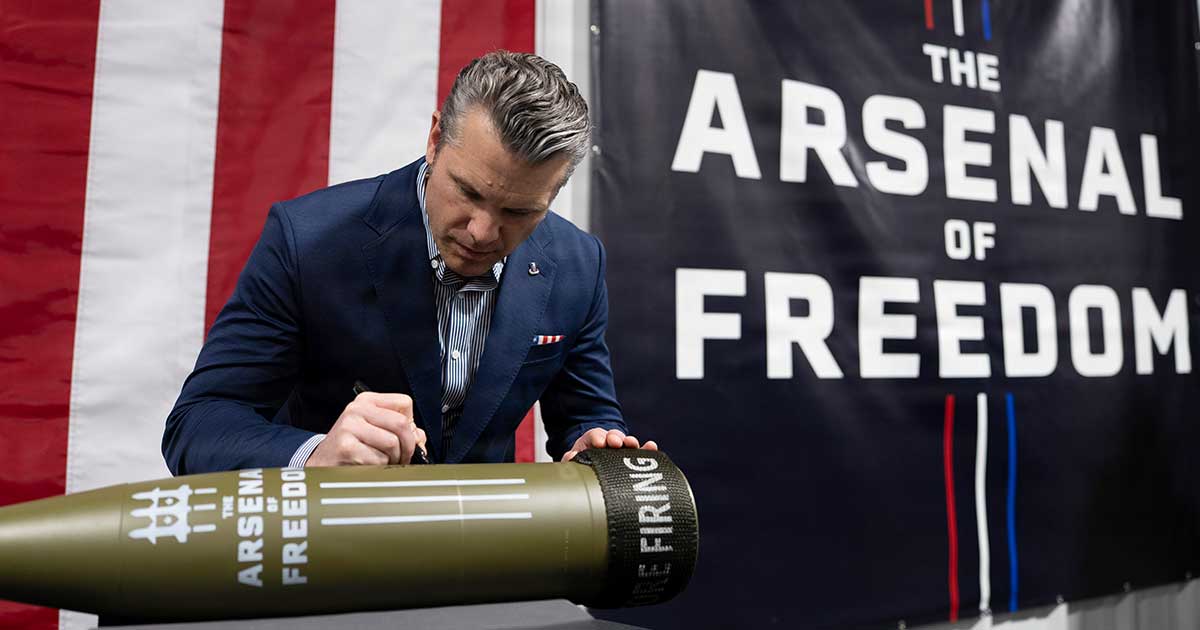
L3Harris, whose Camden campus already produces more than 115,000 solid rocket motors a year and conducts more than 6,000 hot-fire tests, broke ground in November on the Arkansas Advanced Propulsion Facilities — more than 20 buildings across 110 acres that the company says will increase large rocket motor capacity six-fold. Of the $400 million-plus investment, the company has pledged $193 million in spending with Arkansas businesses. In June it announced two additional self-funded buildings dedicated to PAC-3 propulsion, and the Pentagon took the unusual step of making a $1 billion direct equity investment in the company’s missile propulsion business. Defense Secretary Pete Hegseth chose the Camden campus as the final stop of his “Arsenal of Freedom” tour in February.
Raytheon and Israel’s Rafael opened their R2S joint venture plant in East Camden in November — the first U.S. facility to fully assemble the Tamir interceptor used by Iron Dome — and announced a $1.25 billion contract the same day. General Dynamics opened a $110 million artillery shell plant in Calhoun County last year, targeting 50,000 155mm projectiles a month, alongside its existing Javelin and Hellfire work at the park.
The state has felt the political weight that comes with it: the House Armed Services Committee chairman toured the park this spring, and aerospace and defense is now Arkansas’s largest export category, topping $950 million in 2024, according to the Arkansas Economic Development Commission.
Jobs, training — and a county still shrinking
The workforce math is the buildup’s central tension. Highland Industrial Park employs more than 2,500 people, with hundreds more positions promised, and Southern Arkansas University Tech landed a $20 million federal appropriation this year — secured by Sen. John Boozman — to build a Defense Manufacturing Center of Excellence in East Camden, on top of a roughly $5 million state HIRED workforce grant. The school’s chancellor says graduates will step into jobs paying $50,000 to $75,000.
But Ouachita County has lost population for decades — down more than 13% between 2010 and 2020 — and many of the park’s workers already commute from an hour or more away. Whether the boom translates into people actually moving to south Arkansas, and whether housing and schools can absorb them if they do, remains an open question.
Beyond Camden
The buildup is statewide. At Ebbing Air National Guard Base in Fort Smith, construction is accelerating on the international F-35 pilot training center: a roughly $74 million academic training building broke ground in May, a $41.8 million three-bay hangar is underway, and in early August a contractor was awarded $37.6 million to build a classified F-35 Special Access Program facility. Singapore’s F-35s are expected to arrive late this year, with its F-16s to follow in 2027. The AEDC estimates the training mission will generate $1 billion a year in economic impact for the state.
The fine print
For all the record numbers, much of the money is not yet locked in. Both the $58.6 billion PAC-3 contract and the $35 billion THAAD deal are “undefinitized” — final prices, quantities and terms are still being negotiated — and the multiyear munitions strategy behind them has not been fully funded by Congress. Appropriators approved multiyear authority for eight munitions programs in the final fiscal 2026 defense bill but provided well short of the Pentagon’s full request, and analysts note the contracts cannot be finalized until the money is.
The production targets, likewise, are company projections. Tripling missile output by 2030 depends on solving the very bottlenecks — propellant supply, inspection capacity, skilled labor — that created the shortage in the first place.
What is certain is that the stakes now run through Arkansas. When the next conflict draws down American stockpiles, the speed of the response will be decided in large part by what gets built — and who gets hired — in the pine woods east of Camden.
Get the biggest Arkansas stories in your inbox
Breaking news, arrests and court updates from across the state. Free.
Confirmation email required. Powered by Mailchimp.