CAMDEN, Ark. – Two South Arkansas defense plants are at the heart of a national scramble to replenish American weapons stockpiles drained by more than six months of war with Iran, according to a report that aired Sunday on “CBS Sunday Morning.”
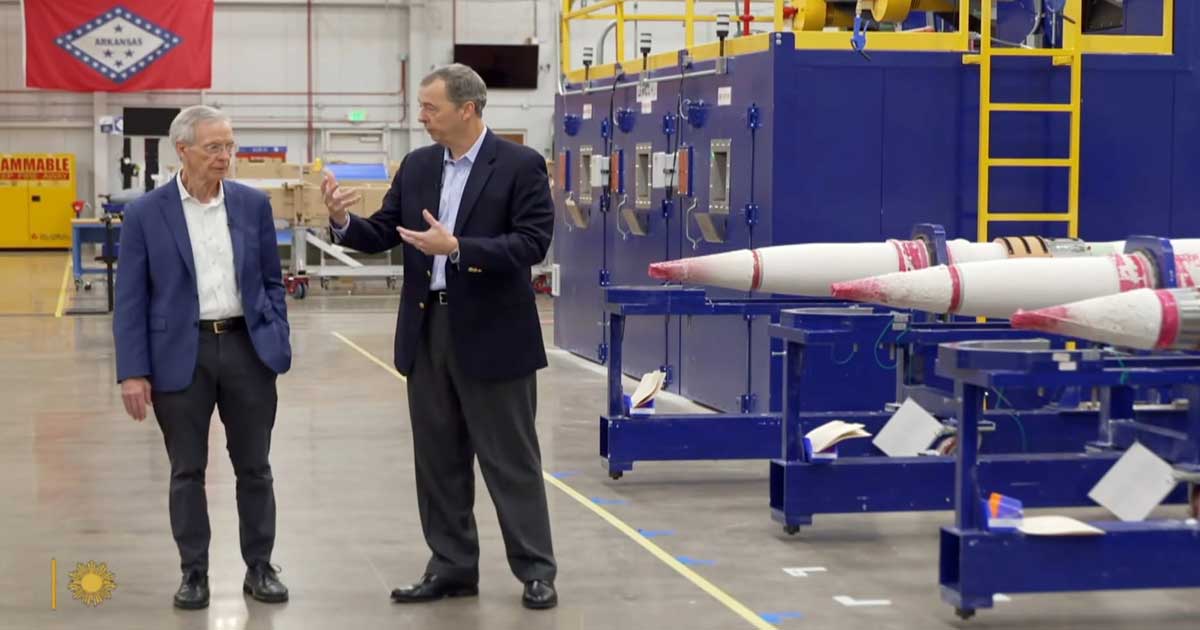
The segment, reported by CBS News national security correspondent David Martin, marked the first time a television news crew has been allowed to film on the production floor at Lockheed Martin’s Patriot missile plant in Camden. The plant builds the newest version of the Patriot interceptor, the weapon the U.S. relies on to shoot down incoming ballistic missiles.
Tim Cahill, who heads Lockheed Martin’s missile division, told CBS the interceptor destroys its target by direct impact, “bullet hitting a bullet,” and vaporizes whatever it strikes.
Each Patriot costs about $4 million, and the Camden plant currently produces about 750 a year. That is well short of what the military needs. CBS reported an estimated 1,500 Patriots have been fired in the war against Iran, which began with U.S. strikes in February and is now in its seventh month.
Mark Cancian, a senior adviser at the Center for Strategic and International Studies who has tracked the use of the Patriot and six other critical weapons in the conflict, estimated the U.S. has fired roughly $25 billion worth of munitions at Iran.
“It depleted the stockpiles quite considerably,” Cancian said.
Cancian told CBS the U.S. has enough weapons to see the Iran war through, but a conflict with China would be a different story. He said the U.S. might be able to supply enough munitions for a month, with months two through four presenting “a great challenge.”
The Pentagon disputes that there is any shortage. CBS reported the department says claims of munition shortfalls are false and only embolden enemies to attack American troops. At the same time, Defense Secretary Pete Hegseth has been pushing defense contractors to move to what he calls a wartime footing, calling for “speed, scale, volume, efficiency, maximum urgency.”
Camden ramping up
Cahill said Lockheed Martin intends to increase Patriot production in Camden from 750 a year to 2,000 by adding shifts and automating more of the assembly line.
“It’s controlled chaos is what it is,” Cahill said of the push. “Move fast, figure it out. Find what our obstacles are, break them down.”
The bottleneck is not assembly. A Patriot takes about six weeks to put together, but the roughly 4,000 parts that go into it take about two years to manufacture. Cahill said Lockheed relies on a supply chain of 500 to 1,000 companies, and many of its systems depend on single-source suppliers.
“All it takes is one single part somewhere along the line to keep us from building up,” he said. Asked whether the plant has been held up waiting on a part, Cahill answered, “We have always, yeah.”
Lockheed Martin recently signed a $59 billion contract to build Patriots, CBS reported.
Rocket motors five miles away
The rocket motors that power the Patriot are built about five miles from the Lockheed plant by L3Harris, which took over the former Aerojet Rocketdyne operation in Camden when it acquired that company in 2023.
Ken Bedingfield, L3Harris’ president of missile solutions, told CBS the rocket fuel in each motor has to be cured in an oven, a process he compared to firing pottery in a kiln. The cure can take days to weeks, and the work falls under strict safety rules because the material is dangerous if mishandled.
L3Harris has nearly doubled its production of Patriot motors and has broken ground on a new, more automated plant, but that facility is still about 16 months from completion.
Like Lockheed, the company’s schedule depends on parts it cannot always get. Bedingfield said nozzles and end cones are “schedule challenged,” and that in some cases there is only one qualified supplier.
“We want that to be the absolute exception, not the rule,” he said.
A cheaper alternative
The report also looked at a different approach to the shortage. CoAspire, a startup in Manassas, Virginia, run by Doug Denneny, is building small cruise missiles that cost a couple hundred thousand dollars each, a fraction of the price of high-end cruise missiles.
The weapons have just 200 parts, some of them commercial products, including an engine that came from the hobbyist market and BBs glued into the nose for ballast. Denneny acknowledged they are less capable than traditional cruise missiles, but said launching thousands of them would overwhelm even a sophisticated air defense system.
CBS reported the Pentagon plans to buy 10,000 low-cost cruise missiles from CoAspire and other startups. The company is working on about $400 million in contracts.
The buildup is being paid for by record trillion-dollar defense budgets that polls show a majority of Americans do not support, according to the report.
Cancian told CBS the U.S. is one to five years away from restoring its stockpiles to pre-war levels, depending on the weapon, and several years beyond that from reaching a level war planners would be comfortable with in a conflict with China.
The full “CBS Sunday Morning” segment is available at cbsnews.com.
Get the biggest Arkansas stories in your inbox
Breaking news, arrests and court updates from across the state. Free.
Confirmation email required. Powered by Mailchimp.