LITTLE ROCK — A legislative committee will hear Monday from utilities, Walmart and farmers about a 2025 law that lets Arkansas power companies charge customers for new power plants years before they produce electricity.
The Joint Committee on Energy meets at 2 p.m. Monday, Oct. 19, in Room A of the Multi-Agency Complex at the state Capitol. The agenda is devoted to the Generating Arkansas Jobs Act, Act 373 of 2025. Its leaders have said publicly that they want to change the law when the Legislature convenes Jan. 11.
Sen. Jimmy Hickey Jr. of Texarkana and Rep. Dolly Henley of Hope both sit on the committee.
What the law does
Traditionally, an Arkansas utility pays to build a power plant up front, usually with borrowed money and shareholder cash. It begins charging customers only after the plant starts running. The financing costs that build up during construction are added to the plant’s price and recovered over its life.
Act 373 lets a utility skip that wait for projects the Arkansas Public Service Commission designates as “strategic investments.” The utility can add a separate charge, called a rider, to monthly bills while the plant is still being built. Utility regulators call this construction work in progress.
Article continues below
▼ Continue reading
The bill passed in March 2025 and was signed March 18, 2025. Rep. Les Eaves, R-Searcy, a sponsor, said at the time the goal was to “make sure that over time, Arkansas has the lowest possible utility rates that we can.”
Who is paying it now
According to the Public Service Commission’s first annual report on the law, filed June 30, three utilities have been approved for the rider: Entergy Arkansas, Black Hills Energy Arkansas and Oklahoma Gas & Electric. Only Entergy and Black Hills had filed annual rider updates by then, so the report covers only those two. OG&E will be included in future reports.
Entergy Arkansas customers started seeing the charge on bills in June. The utility estimated it would add about $5.77 a month for a household using 1,000 kilowatt-hours, Talk Business & Politics reported in March. A federal nuclear tax credit offset part of that, for a net increase of about $4.22. In all, Entergy began collecting nearly $110 million from customers through the rider, the Democrat-Gazette reported.
The rider covers three Entergy projects, none of them finished. Commission-approved costs for each:
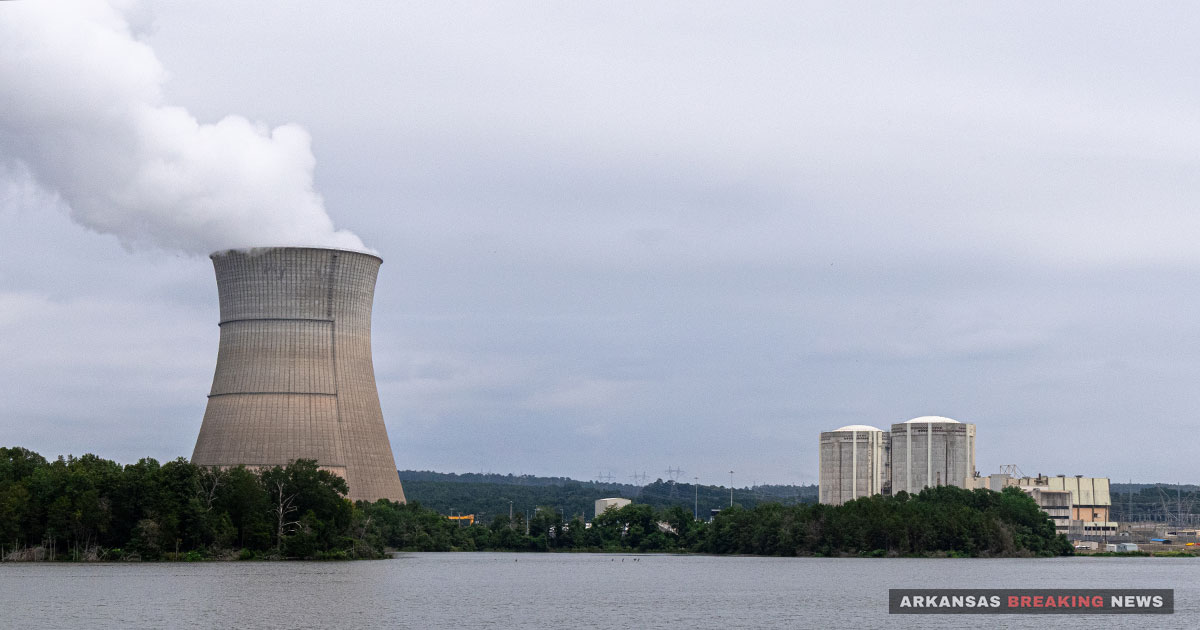
- Jefferson Power Station, a 754-megawatt natural gas plant at the White Bluff site near Redfield: about $1.5 billion
- Ironwood, a 446-megawatt gas plant at Lake Catherine in Hot Spring County: about $542 million
- Cypress Solar, a 600-megawatt solar farm with a 350-megawatt battery near Pastoria: about $1.6 billion. It is being built largely to serve Google’s $4 billion data center in West Memphis.
The charge is set to grow as construction continues. In a presentation filed for Monday’s meeting, Entergy projects the rider will reach about $20.10 a month per 1,000 kilowatt-hours by its fifth year.
Entergy: ‘Same cost, but a timing difference’
Entergy argues the law saves customers money. Paying financing costs as they come up, instead of letting them build on the plant’s price, means customers pay less over time, the company says.
According to Entergy’s figures for Monday’s hearing:
- During construction, 2026 through 2029, customers will pay about $1 billion through the rider for the three plants. Under the traditional method, they would have paid about $234 million in that period.
- Once the plants are running, 2030 through 2059, customers would pay about $3 billion less than under the traditional method.
- Over the plants’ lives, Entergy puts the net savings at $2.25 billion. Adjusted to today’s dollars, the company puts the savings at $368 million.
The company also says the rider avoids “rate shock.” Under the traditional method, Entergy projects bills would jump about $25.13 per 1,000 kilowatt-hours in a single rate case once all three plants were running.
“It’s the same cost, but it’s a timing difference,” John Bethel, Entergy Arkansas’ director of public affairs, told the committee in September, the Arkansas Advocate reported.
Critics: Customers become the bank
Critics say the law shifts the risk of building a plant from the utility’s lenders and shareholders onto its customers. They also note that today’s customers are paying for plants they may never use, which is a particular concern for older residents on fixed incomes.
Sen. Mark Johnson, R-Ferndale, co-chairs the committee and voted against the bill on its first Senate vote. He called the law a “terrible precedent” on Oct. 13 at the emPOWER Arkansas conference, hosted by the Arkansas Advanced Energy Association in Little Rock, the Arkansas Democrat-Gazette reported.
“I think we’re going down a dangerous road,” Johnson said, according to the newspaper.
Johnson said the law makes customers, rather than a utility’s lenders or shareholders, carry the cost of building its plants.
“You’re taking the debt off of the balance sheet of the utility, and when your debt makes your balance sheet look a whole lot better, the stock price goes up,” he said.
At the committee’s Sept. 15 meeting, Johnson asked why the traditional model no longer works when “for 100 years we’ve been doing it this way,” the Advocate reported.
Even some of the bill’s supporters now want changes. Rep. Aaron Pilkington, R-Knoxville, voted for the law. He told the conference he is talking with House colleagues about adding caps on what utilities can recover, clearer explanations of how the charge works, and help for seniors on fixed incomes.
“Arkansas desperately needs more power, and in my opinion, what we need to do is build as much power as possible,” Pilkington said. “How we do that, it’s up to debate.”
Sen. Clint Penzo, R-Springdale, voted “present” on final passage. He said he expects the law to be revisited in the coming session, according to the Democrat-Gazette.
The Google question
Much of the recent criticism focuses on Cypress Solar and Google.
The Public Service Commission approved Entergy’s 20-year special rate contract with Google in December, and most of its terms remain confidential. Lawmakers have asked why all Entergy customers are paying for the solar project through the rider while Google is making large advance payments to the utility.
Newly unredacted documents filed with the commission show Google will make $443 million in accelerated payments to Entergy, the Democrat-Gazette reported Sunday:
- $10 million in 2025
- $103 million in 2026
- $145 million in 2027
- $120 million in 2028
- $65 million in 2029
Google is also expected to pay $83 million in minimum demand payments. Over the life of the contract, Google is projected to pay Entergy more than $2.1 billion, which is more than the cost of Cypress Solar, according to the newspaper.
None of that money will go toward building Cypress Solar. In its filing for Monday, Entergy says it instead spreads Google’s advance payments across all customers’ bills over 20 years, lowering rates by about $27.5 million a year. If the payments went toward construction, Entergy says, only Google’s own rate would go down. The company also says Cypress Solar will serve all customers, not just Google.
Entergy sued the Democrat-Gazette in federal court in September after the newspaper published details of the contract from a commission staff memo. A federal judge refused to order the newspaper to remove its story, and Entergy later dropped the lawsuit.
What it means locally
Most Texarkana, Arkansas, homes and businesses get electricity from Southwestern Electric Power Co. (SWEPCO), not Entergy.
SWEPCO, a subsidiary of American Electric Power, sought to use the law within days of its signing. On March 26, 2025, the company asked the Public Service Commission to rule that two Texas gas projects qualify as strategic investments even though they are out of state, the Democrat-Gazette reported:
- a 450-megawatt plant at the former Pirkey coal plant site in Hallsville, Texas
- the conversion of the Welsh coal plant in Titus County, Texas, to natural gas
Commission staff testified that the Welsh project qualified but that the Hallsville plant did not meet any of the law’s three tests for out-of-state projects. SWEPCO was not among the utilities approved for the rider as of the commission’s June 30 report.
SWEPCO customers have already absorbed one large increase this year. In January, the commission approved a settlement in SWEPCO’s rate case that raised the average residential bill by about $17.50 a month, or 23%, according to the company.
A separate SWEPCO filing is pending. It would add about $4.48 a month for an average home starting with February 2027 bills.
Rural customers of Southwest Arkansas Electric Cooperative, which is based in Texarkana, are in a different position. The state’s electric cooperatives told the committee in a written statement for Monday that they “have not utilized, and do not plan to utilize” the rider. Their tariffs require large new customers such as data centers to pay for the infrastructure built to serve them, the cooperatives said.
How the area’s lawmakers voted
The bill failed on its first Senate vote, 17-11, on March 5, 2025. Hickey and Johnson were among the 11 no votes.
The bill was then amended and passed the Senate 27-1 on March 12. Hickey and Sen. Steve Crowell of Magnolia voted yes, while Johnson and Penzo voted “present.”
The House passed it 77-13 on March 18. Reps. Carol Dalby of Texarkana, Henley and Lane Jean of Magnolia voted yes. Rep. DeAnn Vaught of Horatio voted “present.”
Monday’s lineup
The committee will hear from:
- Public Service Commission Chairman Doyle Webb and chief of staff Danni Hoefer
- Economists Eric Olson of Florida State University’s Institute for Governance and Civics and Jason Walter of the University of Tulsa, on the construction work in progress provision
- Steve Chriss of Walmart and Lauren Waldrip of the Arkansas Advanced Energy Association, on commercial and retail businesses
- Four farmers: Lori Caveness and Don Kittler of Carlisle, Wendi Stacks of Hazen and Cory Skarda of Des Arc
- Buddy Hasten of Arkansas Electric Cooperative Corp. and Jennifer Loiacano of the Electric Cooperatives of Arkansas
- Bethel and David Palmer, Entergy Arkansas’ vice president of regulatory affairs
The meeting will be streamed live on the Legislature’s website, arkleg.state.ar.us. No vote is scheduled.
What happens next
Bills for the 2027 session can be prefiled starting Nov. 16. The session convenes Jan. 11.
In the meantime, the rider stays on Entergy bills. The company files an annual update around March 1, and changes take effect with June bills. The Public Service Commission must also file its next report on the law with the Legislature by June 30, 2027.
Get the biggest Arkansas stories in your inbox
Breaking news, arrests and court updates from across the state. Free.
Confirmation email required. Powered by Mailchimp.