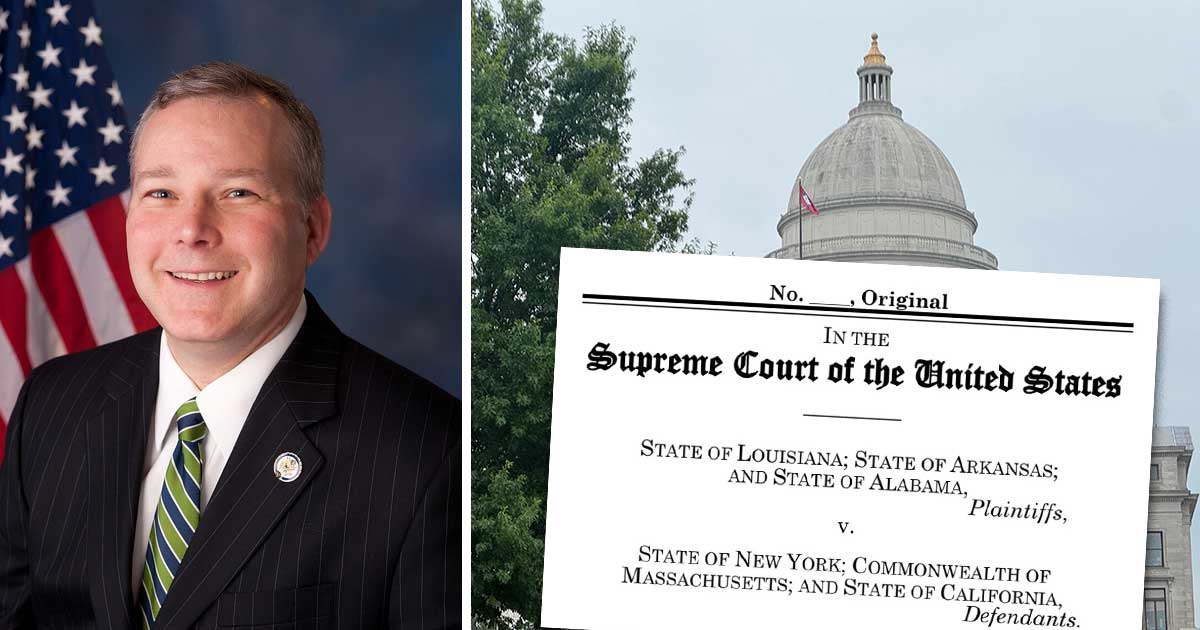
BATON ROUGE, La. – Arkansas Attorney General Tim Griffin joined Louisiana and Alabama on Wednesday in a two-pronged legal attack on mail-order abortion pills: a 100-page federal lawsuit against the out-of-state doctors, nurses, nonprofits and pharmacies that ship the drugs into the three states, and a request that the U.S. Supreme Court strike down the “shield laws” in New York, Massachusetts and California that protect those providers.
The lawsuit, Louisiana v. Nouhavandi, was filed Sept. 30 in U.S. District Court for the Western District of Louisiana, Lake Charles Division, and is docketed as case 2:26-cv-03836. No judge had been assigned as of Thursday.
Griffin’s office described the suit as an action against 29 defendants. The caption of the complaint lists 30 names, counting a California mail-order pharmacy and its two owners, a Massachusetts nonprofit and three of its officers, a California physician and his related companies, and a string of midwifery and reproductive-health practices in Maryland, Washington, D.C., New Jersey, Maine and Delaware.
“Following a multi-year investigation, today we have filed a civil suit against 29 defendants for violating federal public nuisance common law,” Griffin said in a statement released after a joint news conference in Baton Rouge. “Our claims against the individuals and organizations behind this commercial operation also include violations of Arkansas’s consumer-protection laws.”
The complaint’s first count asks the court to declare that shipping abortion drugs into the three states is a public nuisance under federal common law and to order the defendants to stop. Three more counts, brought by Arkansas alone, accuse every defendant of violating the Arkansas Deceptive Trade Practices Act through unconscionable practices, knowing misrepresentations and material omissions. Arkansas asks for civil penalties of $10,000 per violation, an injunction, disgorgement of revenue, damages and attorneys’ fees.
Louisiana and Alabama bring parallel counts under their own trade-practices laws.
What the complaint says about Arkansas
Arkansas bans abortion except to save the life of the mother and, under a separate statute, makes it unlawful “for any manufacturer, supplier, physician, or any other person to provide any abortion-inducing drug via courier, delivery, or mail service.” The complaint cites both laws, along with Amendment 68 to the state constitution, which declares that “the policy of Arkansas is to protect the life of every unborn child from conception until birth.”
Citing a Society of Family Planning report that tracked data through December 2025, the states say about 300 abortions a month are occurring in Arkansas despite the ban, about 1,000 a month in Louisiana and about 700 a month in Alabama. The states attribute all of them to drugs mailed from out of state.
The complaint says the three states’ investigators tested the providers’ screening by ordering pills with fabricated patient information. In one instance, according to the complaint, a man completed the online intake for the Massachusetts Medication Abortion Access Project, known as The MAP, using identification that depicted a woman, with a payment name and billing address that did not match the patient. The MAP never spoke with the supposed patient and shipped the drugs anyway, including a package to Arkansas in April 2026, the complaint says.
Investigators ran the same test on A Safe Choice Network and OPTIO Women’s Health, two California operations tied to physician Remy Coeytaux, and received a shipment in Arkansas in March 2026, the complaint says.
The states say Coeytaux’s operation mailed more than 200 abortion-drug packages to Arkansas addresses between 2025 and mid-2026, along with nearly 500 to Louisiana and more than 500 to Alabama, and that by 2026 he was handling hundreds of packages a month and clearing more than $100,000 a month in profit. The complaint says he also fills orders for Aid Access, the Europe-based provider, and that the states “will soon file a separate lawsuit” against Aid Access because of the complications of serving a foreign defendant.
The MAP, founded by Angel Foster in Somerville, Massachusetts, in 2023, has said it fills more than 6,000 orders a month, 95 percent of them to states where abortion is banned or heavily restricted, according to a Mother Jones profile that the complaint attaches as its first exhibit. The complaint quotes Foster describing the operation as “set up around distributed risk,” with different people ordering, packaging and mailing the pills so that it is “really hard to identify an individual person who provided pills to an individual patient.”
The states also allege the providers advertise the drugs as “safer than Tylenol,” downplay the rate of complications, and coach women who need emergency care to tell Arkansas doctors they are having a miscarriage.
Griffin had warned some of the operators before suing. His office sent cease-and-desist letters in July 2025 to two pill providers and to the domain registrar and hosting company behind a website promoting the drugs in Arkansas. The complaint says the states “expressly notified certain Defendants or their website hosts” that they were breaking Arkansas and Alabama law, and “the activity has not stopped.”
Arkansas Solicitor General Autumn Hamit Patterson and Senior Assistant Attorney General Brittany Edwards signed the complaint for the state.
The Supreme Court filing
The second filing is rarer. The three states asked the Supreme Court for leave to file a bill of complaint directly against New York, Massachusetts and California under the court’s original jurisdiction over disputes between states. The justices decide whether to accept such cases, and the filing does not yet have a docket number.
Shield laws, passed in the three defendant states after the 2022 Dobbs decision, bar state officials from cooperating with out-of-state subpoenas, warrants and extradition requests tied to abortion, protect providers from professional discipline, and in New York’s case let prescribers keep their names off the pill bottle.
The 67-page filing argues those laws violate the Full Faith and Credit Clause, the doctrine of equal state sovereignty, the federal common law of public nuisance and the dormant Commerce Clause. It calls them “swords disguised as shields and driven into pro-life states” and asks the court to declare them invalid and bar officials in the three states from enforcing them.
Much of the filing recounts Louisiana’s 2025 indictment of New York physician Margaret Carpenter for mailing abortion pills to a Louisiana teenager, and New York Gov. Kathy Hochul’s refusal to extradite her. The states quote Hochul saying “there’s no way in hell” she would turn Carpenter over.
“These laws unconstitutionally nullify the laws of pro-life states by insulating abortion providers from liability in Arkansas,” Griffin said. “The rule of law matters, and with this action, we are sending a clear signal that our states take our laws seriously.”
Louisiana Solicitor General J. Benjamin Aguiñaga is counsel of record. Griffin, Louisiana Attorney General Liz Murrill and Alabama Attorney General Steve Marshall also signed. Griffin led a 16-state letter in 2025 asking Congress to preempt shield laws by statute.
Reaction
New York Attorney General Letitia James said the three states “are asking the Supreme Court to let them impose their abortion bans on New York and punish our doctors for providing legal health care,” and said New York would defend its law.
Massachusetts Attorney General Andrea Campbell said her office “will vigorously defend the law and our authority to protect the rights and privacy of our residents.”
Amanda Allen of the Abortion Coalition for Telemedicine, which represents shield-law providers, called the district court case “a desperate bid to weaponize the legal system against providers working to ensure patients can access safe, private abortion care.”
“This is the first time we’ve seen a state or group of states suing other states to challenge the validity of shield laws,” Mary Ziegler, a University of California, Davis, law professor and author of seven books on abortion law, told The Associated Press. She said the three states would have a stronger case if they had first asked the high court in one of the shield-law states to order its officials to cooperate.
Employees at OPTIO Women’s Health and With Open Arms Center for Reproductive Choices, two of the California defendants, declined to comment when reached by the Arkansas Democrat-Gazette. The MAP and Foster had not responded publicly as of Thursday.
The district court complaint and the Supreme Court filing are posted on the attorney general’s website.
Get the biggest Arkansas stories in your inbox
Breaking news, arrests and court updates from across the state. Free.
Confirmation email required. Powered by Mailchimp.