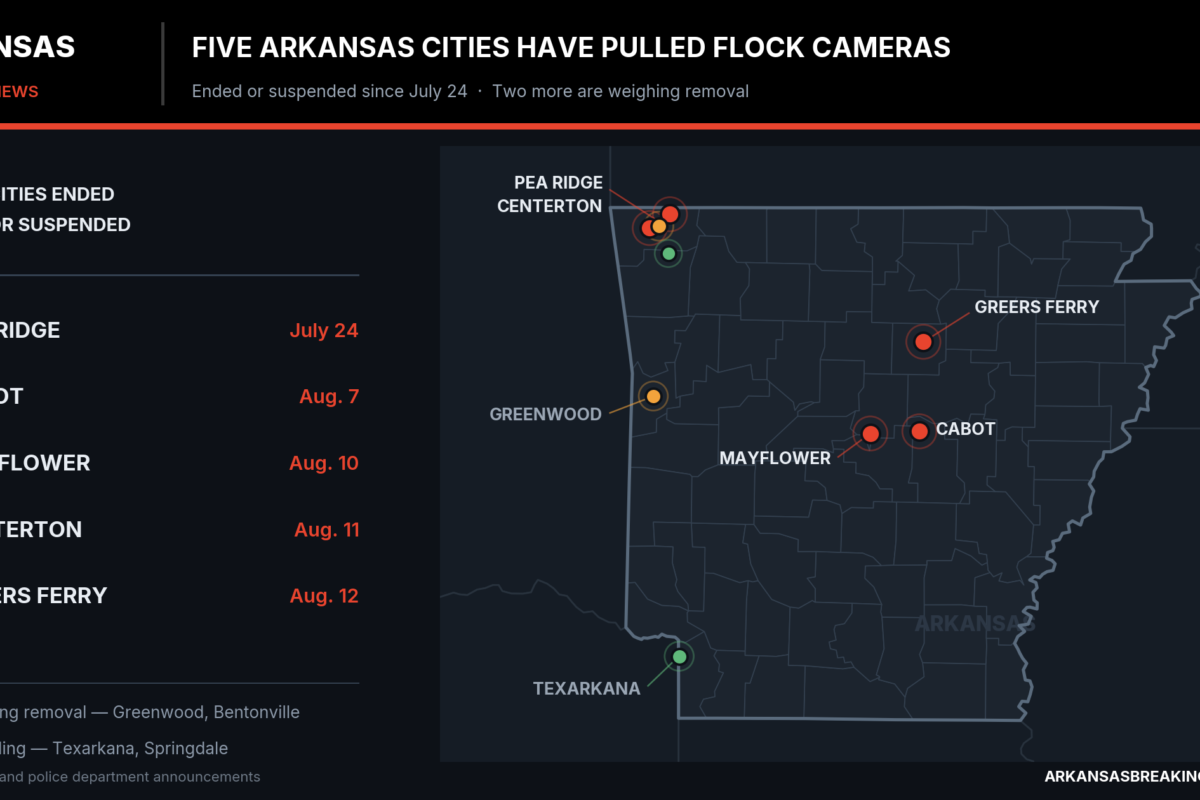
GREERS FERRY — This Cleburne County city will begin taking down its Flock Safety cameras, Police Chief David Starbuck announced on Facebook Wednesday morning, making Greers Ferry the fifth Arkansas city in under three weeks to walk away from automated license plate reader technology.
“This decision was not made lightly,” Starbuck wrote. He said community safety has to be balanced against the privacy, trust and concerns of residents, and that the department belongs to the community it serves.
Greers Ferry joins Pea Ridge, Cabot, Mayflower and Centerton, all of which have moved to end or suspend their Flock programs since July 24.
Pea Ridge went first, with its police department citing return on investment, resident concerns and the amount of staff time the debate was consuming. Cabot’s mayor ordered the city’s cameras unplugged and covered on Aug. 7 pending a community review. Mayflower discontinued its contract Aug. 10 — years ahead of a deal that ran through September 2027 — with Interim Chief Brittany Byrd calling the technology “intrusive in nature.” Centerton’s City Council voted unanimously Tuesday night to terminate its contract after residents packed the meeting to object.
Only Centerton’s decision came from a vote of the governing body. The other four came from a police chief or a mayor — a pattern worth noting, because decisions made that way can be reversed the same way.
The cameras and what they capture
Flock’s readers photograph every passing vehicle and log the plate along with the time, location, make, model, color and distinguishing features such as bumper stickers or body damage. Departments can search their own data and, depending on settings, data collected by agencies elsewhere in the country.
The crowdsourced mapping project DeFlock has identified 943 Flock cameras across Arkansas. Sherwood police have put the statewide figure higher, at 1,051.
Not everyone is backing away
The retreat is far from universal. Springdale’s City Council approved a three-year Flock contract on July 22 worth roughly $532,800. Springdale and Little Flock both posted public defenses of their programs last month.
In Bentonville, residents turned out Tuesday to oppose the cameras, but the council took no action. Police Chief Glynn Bertrand told members the department’s five readers do not use facial recognition and that alerts are driven by hot lists tied to the state and national crime information systems, refreshed roughly every five hours.
Greenwood is the next city to watch. Its council held a study session Monday on the 11 cameras operating in town — five belonging to the police department and six near school campuses, funded through an Arkansas Department of Education school safety grant and accessed by police rather than the district. No vote was taken, but members could put the question on the Sept. 4 agenda.
Sen. Brad Simon, R-District 26, attended that meeting and said afterward that Arkansas law has not caught up to the technology. “We cannot give up our Fourth Amendment rights just for safety,” he said, adding that the debate is shaping what he plans to bring to the 2027 legislative session.
Where the law stands
Arkansas is not without an ALPR statute. Ark. Code 12-12-1801 and following govern how license plate reader data is collected and retained — but the law predates the current fight, and departments do not agree on what it requires them to disclose.
The Texarkana, Arkansas Police Department removed its public search-audit log earlier this year, with Capt. Zach White pointing to Ark. Code 12-12-1802 and 12-12-1804 and arguing the statutory definition of captured plate data covers the search records themselves. Fort Smith read the same statute differently and kept publishing its log.
Both Texarkana departments are moving in the opposite direction from the rest of the state. On the Texas side, residents asked the City Council in July to cancel the city’s contract; the department responded Aug. 6 with a public defense of the system, crediting it in a capital murder arrest, the recovery of a missing woman with dementia and an ATM theft on Stateline Avenue. It continues to promote the program on social media.
Nationally, the ACLU counts more than 50 municipalities that have ended Flock contracts in the past year. The company says it operates in more than 6,000 communities.
Get the biggest Arkansas stories in your inbox
Breaking news, arrests and court updates from across the state. Free.
Confirmation email required. Powered by Mailchimp.