A study on whether Arkansas should build new nuclear reactors goes before state lawmakers on Aug. 6, and a draft released earlier this year already points to six regions where the power grid could absorb a new plant.
The Joint Committee on Energy is scheduled to receive the final report from EXCEL Services Corporation, a Rockville, Maryland, consulting firm that specializes in nuclear licensing. The Bureau of Legislative Research hired the firm under a contract capped at $305,000 that runs through Sept. 26.
The study exists because of Act 707 of 2025, which directed the Arkansas Department of Energy and Environment to examine the feasibility of new nuclear generation. That work went unfunded, so the legislature’s energy committee took it on instead.
EXCEL delivered interim findings in February. The draft is stamped “for review purposes only,” and its final version could change. But it gives the clearest look yet at where this is headed.
Six areas of interest
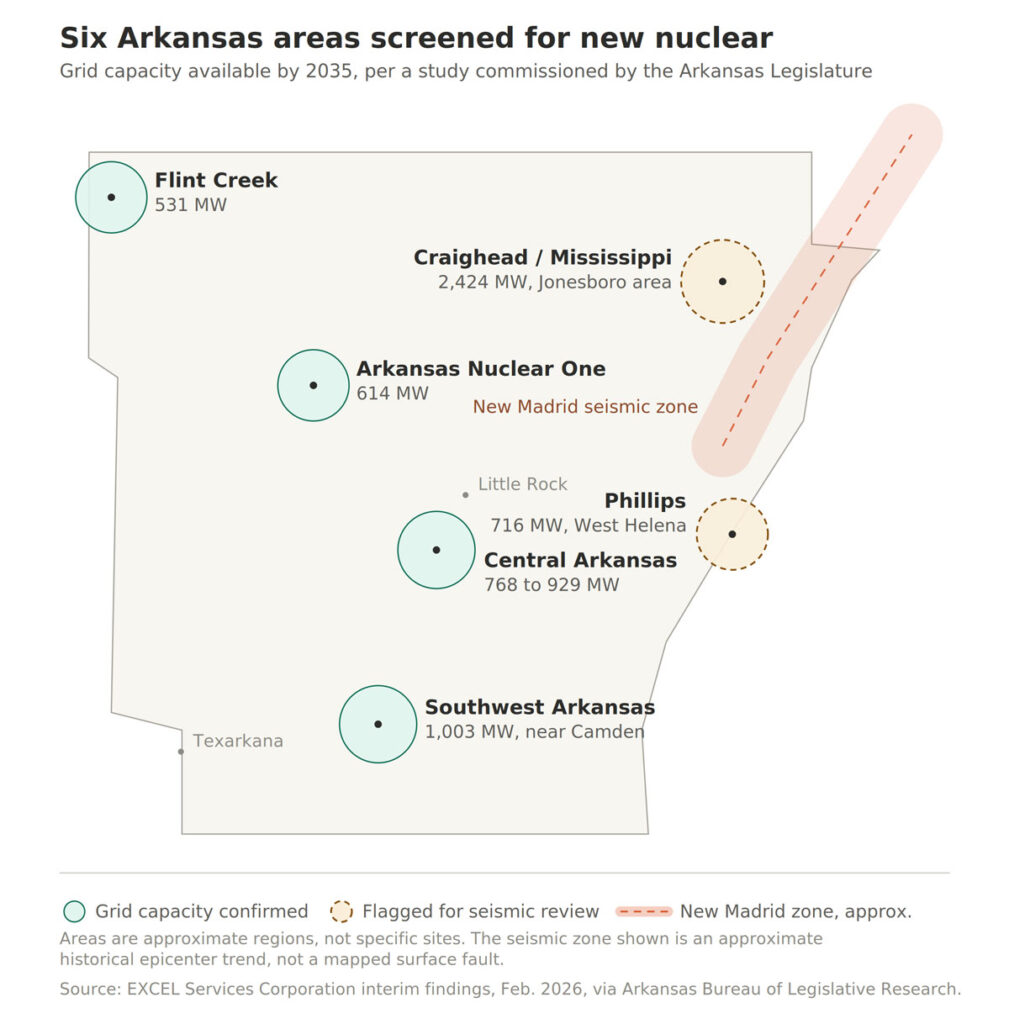
The consultants screened the state by asking a narrow question: where can the existing transmission system take on a large new generator without expensive upgrades? That analysis produced six areas, each rated by how many megawatts the grid could absorb under a 2035 outlook.
| Area | Location | Grid headroom | Status |
|---|---|---|---|
| Flint Creek | Northwest Arkansas | 531 MW | OK |
| Arkansas Nuclear One | Russellville area | 614 MW | OK |
| Central Arkansas | Hot Springs, Keo, Sheridan | 768 to 929 MW | OK |
| Southwest Arkansas | Near Camden | 1,003 MW | OK |
| Phillips | West Helena | 716 MW | Seismic review |
| Craighead and Mississippi | Jonesboro area | 2,424 MW | Seismic review |
The last two carry a caveat. The draft says their proximity to the New Madrid fault may limit which reactor designs could be used there and requires further seismic study.
The draft is explicit that these are broad regions, not parcels. It calls the map “schematic” and lists completing the siting analysis, including seismic, water and land use screens, as the first of seven recommended next steps.
What the state is being asked to do
EXCEL concludes that private investors will not carry a first-of-a-kind nuclear project in Arkansas through development and construction on their own. Its recommended fix puts the state on the hook in three places:
- A bridge loan program. State money to cover early costs including site studies, engineering, permits and long-lead equipment orders, before any financial close.
- A cost overrun backstop. A state-guaranteed “completion assurance” designed to reduce what lenders call finish risk, which the draft says would unlock cheaper federal Department of Energy and export credit agency debt.
- Long-term offtake support. State help securing a creditworthy buyer for the power under a long-term contract.
The draft also lists rate recovery for construction work in progress, a regulatory mechanism that lets a utility bill customers for a plant while it is still being built rather than after it starts producing power.
“Passive equity investors are unlikely to participate during Development and Construction,” the draft states. “State support is essential to bridge this gap.”
That recommendation lands against a live cost history. Entergy CEO Drew Marsh told an Arkansas Economic Development Foundation audience in May that cost overruns alone at Georgia’s Plant Vogtle exceeded the entire size of Entergy Arkansas, and that new nuclear here would require help from the federal government or from data center customers with very large balance sheets.
The jobs case, and the coal angle
The draft estimates a representative small modular reactor would support more than 200 permanent on-site jobs over a 40-year operating life, about 1,600 construction jobs across a roughly three-year build, and more than 70 spillover engineering and professional positions, at wages it describes as higher than coal.
It leans hard on converting retiring coal sites, which come with transmission already built, a trained workforce and local support. Under a federal consent decree, Entergy Arkansas must stop burning coal at White Bluff in Jefferson County by the end of 2028 and at Independence County’s Independence plant by the end of 2030.
The draft also names artificial intelligence and data center demand as a reason technology firms could become equity partners and power buyers, and suggests Arkansas could attract data center co-location at nuclear sites.
What the draft does not say
The interim findings do not recommend a reactor design, a vendor, a site, a construction cost or an in-service date. They do not estimate what a state bridge loan or overrun backstop would cost taxpayers if a project stalled.
EXCEL is working with two subcontractors. One is Murphy Energy & Infrastructure Consulting. The other is Nucleon Energy Inc., a Canadian company that develops small modular reactors and that, under the arrangement approved by the energy committee, is helping build the siting criteria and the grid analysis.
The plant Arkansas already has
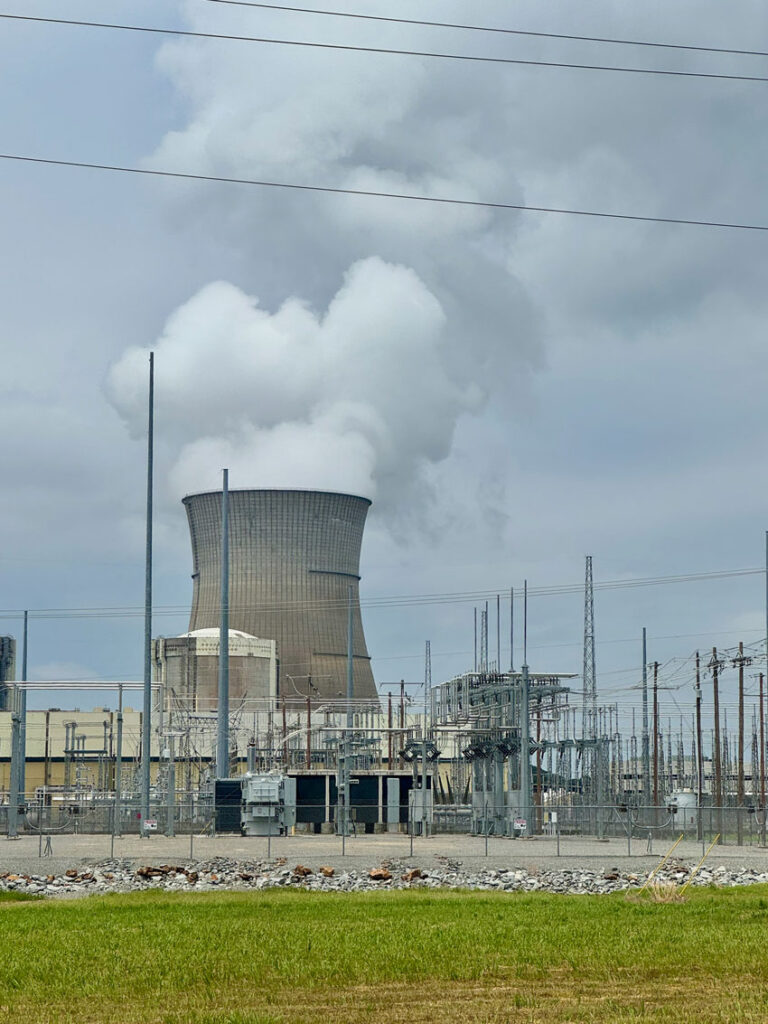
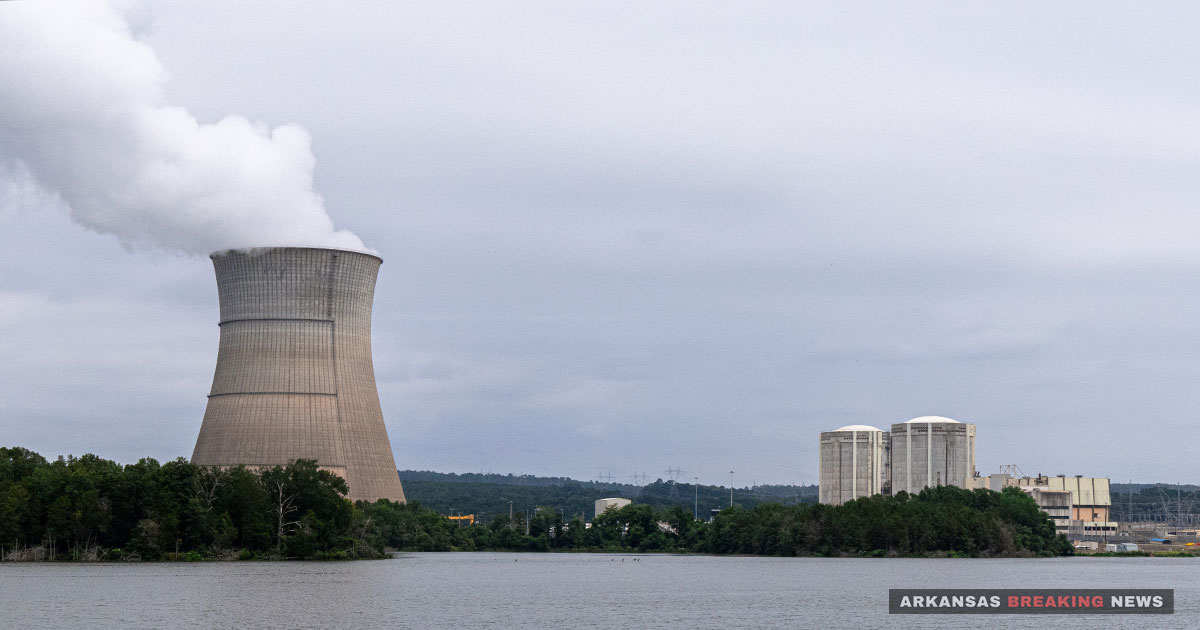
Arkansas Nuclear One near Russellville remains the state’s only nuclear plant. Its two pressurized water reactors produce about 1,800 megawatts. Entergy says the plant supplies roughly 20% of the electricity used in Arkansas and about 56% of the energy consumed by Entergy Arkansas customers.
Unit 1 came online in 1974 and is licensed through 2034. Unit 2 started in 1980 and is licensed through 2038. Entergy said in December it intends to seek 20-year extensions that would carry the units to 2054 and 2058, and engineering firm Sargent & Lundy announced in March it is preparing the Unit 1 application.
Unit 2 returned to service in early May after an outage that began March 14. Entergy put the work at more than $200 million across roughly 13,000 tasks and 195,000 labor hours, including replacement of the reactor vessel head, which site officials framed as groundwork for the license extension.
The Aug. 6 meeting is expected to be the study’s formal handoff to the legislature. Any bridge loan or backstop would require action by lawmakers.
Get the biggest Arkansas stories in your inbox
Breaking news, arrests and court updates from across the state. Free.
Confirmation email required. Powered by Mailchimp.