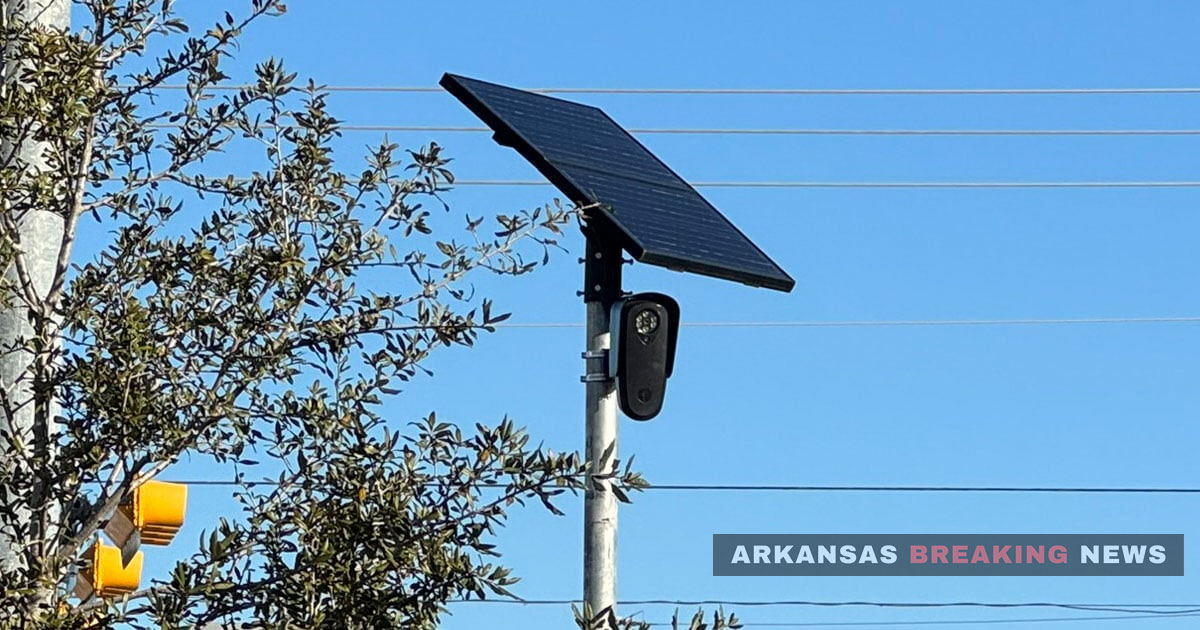
PEA RIDGE, Ark. — A Northwest Arkansas police department has shut down its Flock Safety license plate reader program after three weeks of resident pressure, making Pea Ridge the first Arkansas city known to walk away from the surveillance technology.
Pea Ridge Police Chief Lynn Hahn announced the decision in a news release Friday afternoon, July 24. He emailed the mayor and City Council members shortly before the release went out.
The release said Hahn weighed the benefits of the system, the return on investment the city received, the concerns raised by community members and the amount of time and energy the issue continued to consume.
Pea Ridge approved the cameras in 2024. Seven readers were installed on the outskirts of the city limits. DeFlock, the crowdsourced project that maps license plate readers nationwide, lists five cameras in and around the city.
Hahn did not back away from the technology itself. He said in the release that the system helped officers recover stolen vehicles, identify suspects, locate missing people and support criminal investigations. He said the decision should not be read as a finding that the technology is ineffective or that his officers misused it, and that department personnel followed policy.
He also said many of the concerns raised locally rested on what he called misunderstandings or misinformation.
But he framed the shutdown as a trust decision.
“Effective policing depends not only on using effective tools but also on maintaining the trust and confidence of the community we serve,” Hahn said in the release.
Hahn thanked residents on both sides for engaging, and said the department will be able to do its work without the readers.
The department has declined to answer further questions, pointing back to the release. It is not clear when the cameras will actually go dark.
How it built
The pressure came together in about three weeks, and much of it ran through Facebook.
Questions about the cameras came up at the mayor’s roundtable meeting July 10. Hahn told the room the program had helped solve several cases, and said the issue had recently surfaced on Facebook with a lot of bad information attached.
At a City Council meeting the following week, resident Donivan Tarpley called for the readers to be removed, telling council members the cameras violate Fourth Amendment rights.
On July 22, Pea Ridge resident Aaron Nelson emailed the mayor, the city clerk and council members asking for City Council meeting notices and any Flock Safety agenda items.
Two days later, the program was over.
A first for Arkansas
Arkansas Breaking News reported July 15 that no Arkansas city had canceled a Flock contract, even as roughly 50 cities nationwide had terminated or declined to renew their agreements. Pea Ridge appears to be the first.
The closest prior case never went that far. In Greers Ferry, a Cleburne County town that contracted with Flock in September 2024, one of five cameras was installed outside city limits directly across from the home of Charlie and Angie Wolf, photographing their driveway every time a vehicle passed. After the Institute for Justice sent the city a demand letter in July 2025 arguing the camera amounted to warrantless around-the-clock surveillance, Greers Ferry moved the camera inside city limits and asked Flock to disable it. The contract stayed in place.
Pea Ridge is a city of roughly 7,000 in Benton County, and five to seven cameras is a rounding error against the statewide footprint. ABN’s July analysis found at least 943 license plate readers reported across Arkansas, mapped in 102 cities and 45 counties, ranking the state 28th in the country by camera count. Volunteers added 118 newly mapped readers in the 30 days before that report. The Electronic Frontier Foundation has documented Flock systems in use by roughly 40 Arkansas law enforcement agencies.
The scale sits elsewhere. Little Rock police have disclosed 116 cameras, and the city extended its Flock contract in October 2025 for two years at a cost of $690,000. That December, the Board of Directors rejected a transparency ordinance proposed by At-Large Director Antwan Phillips that would have required public reporting on police surveillance technology. Conway operates 19 fixed readers at eight intersections. Sherwood runs about 15, which have read 29 million plates since the beginning of this year. On the state line, the Texarkana, Arkansas Police Department operates eight, and residents asked the Texarkana, Texas City Council this month to cancel its contract.
What Pea Ridge changes is the precedent. Until Friday, Arkansas cities facing this pressure had responded with statements, transparency portals and camera relocations. None had stopped.
What the law allows
Arkansas regulates the technology under the Automatic License Plate Reader System Act, codified at Arkansas Code § 12-12-1801 and following sections, which restricts the systems to law enforcement purposes and limits how captured data may be kept and shared.
The Legislature expanded the law in 2025. Senate Bill 446, sponsored by Sen. Ben Gilmore, R-Crossett, passed the Senate 32-0 and was signed by Gov. Sarah Huckabee Sanders in April 2025. It allows private landowners, leaseholders and commercial businesses to operate license plate readers on their property, on the condition that the data is deleted after 60 days. State agencies and parking enforcement may hold plate data for up to 150 days.
The statute is largely silent on what happens when a city quits. That leaves an open question in Pea Ridge: what becomes of the plate reads already collected, and how long Flock keeps them.
The sharing question is the other unknown. ABN’s reporting found nine Arkansas law enforcement agencies sharing plate data from hundreds of cameras with a sheriff’s department in Texas hundreds of miles away. When an agency opts into Flock’s national network, plates scanned locally can be searched by thousands of outside departments. Whether Pea Ridge participated in that network, and whether ending the program purges what was already shared, has not been addressed.
Get the biggest Arkansas stories in your inbox
Breaking news, arrests and court updates from across the state. Free.
Confirmation email required. Powered by Mailchimp.