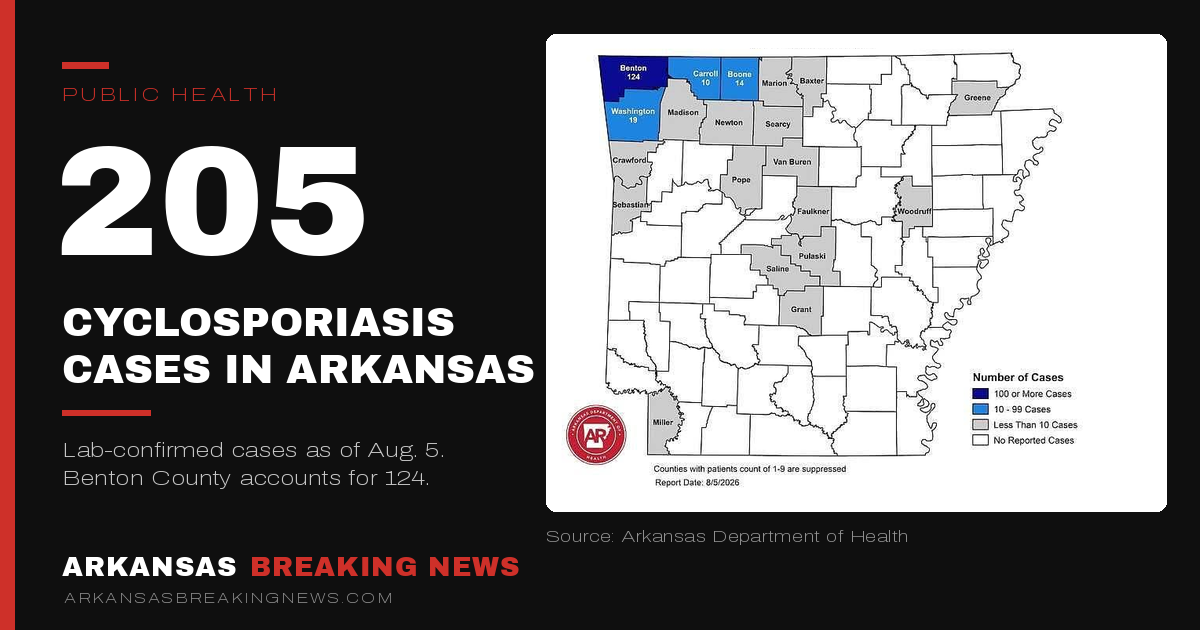
Arkansas has confirmed 205 laboratory cases of cyclosporiasis this year, a twentyfold increase in three weeks, and federal investigators have now folded the state into a national outbreak traced to imported iceberg lettuce.
The Arkansas Department of Health updated its count Wednesday. On July 14 the state had 10 confirmed cases. By July 30 it had 123. As of Aug. 5 the number stands at 205.
Benton County accounts for the bulk of them, with 124 confirmed cases. Washington County has 19, Boone County has 14 and Carroll County has 10. Sixteen additional counties have reported between one and nine cases each, and ADH suppresses those exact numbers to protect patient privacy. They include Baxter, Crawford, Faulkner, Grant, Greene, Madison, Marion, Miller, Newton, Pope, Pulaski, Saline, Searcy, Sebastian, Van Buren and Woodruff.
The Centers for Disease Control and Prevention added Arkansas to its multistate outbreak investigation in an update posted Aug. 5. That outbreak now covers 6,358 illnesses across 15 states, with at least 278 hospitalizations and two deaths reported in Michigan.
ADH says the Arkansas surge is connected to that investigation.
“After an investigation, it was determined that the increase in cases in Arkansas is, in part, associated with the ongoing multistate outbreak,” the department said on its cyclosporiasis page.
What the illness is
Cyclosporiasis is an intestinal infection caused by a microscopic parasite called Cyclospora cayetanensis. People get it by eating food or drinking water contaminated with feces.
It does not pass from person to person the way a stomach virus does. The parasite has to spend days or weeks in the environment before it becomes infectious, so a sick household member is not a danger to the rest of the house. The contamination happens upstream, usually in the water used to irrigate or wash produce.
The parasite infects the small intestine. ADH describes the main symptom as watery diarrhea with frequent and sometimes explosive bowel movements. Other symptoms include cramping, bloating, nausea, fatigue, loss of appetite and weight loss. Symptoms typically start two to 14 days after exposure.
The illness has a signature pattern that catches people off guard. Symptoms can appear to clear up, then return days later. Untreated, the infection can last more than a month.
Cyclosporiasis is treated with the antibiotic trimethoprim-sulfamethoxazole. Most healthy people recover on their own, but people in poor health or with weakened immune systems face longer and more severe illness.
Where it is coming from
CDC and the Food and Drug Administration say epidemiologic and traceback data point to iceberg lettuce processed by Taylor Farms de Mexico and grown in central Mexico.
Taylor Farms recalled all iceberg lettuce sourced from central Mexico on July 17. The recall covered Marketside-brand iceberg salad and shredded lettuce sold at Walmart, along with a longer list of foodservice products. Recalled Marketside product was sold at select Walmart stores in Arkansas. Foodservice product was distributed in Arkansas between June 29 and July 16.
The evidence against the lettuce is circumstantial in a specific sense. FDA reported a positive lettuce sample collected at the border on July 18, then reversed the finding the next day and called it a false positive. As of July 19 there were no confirmed positive product samples. The agency says the case rests on interviews with sick people and on tracing supply chains backward to a common source.
FDA said the reversal does not change its conclusion.
Past cyclosporiasis outbreaks in the United States have been tied to imported fresh produce, including cilantro, raspberries, basil, snow peas, bagged salad mixes and mesclun lettuce.
What to do
ADH recommends washing all fruits and vegetables thoroughly under running water before eating, cutting or cooking them. Wash hands with soap and water before and after handling raw produce. Cut away damaged or bruised areas. Refrigerate cut or cooked produce within two hours.
Washing helps but is not a guarantee. Cyclospora can be difficult to remove completely from some produce surfaces.
Anyone with prolonged diarrhea should contact a health care provider. Diagnosis requires a specific test. Routine ova and parasite exams generally will not detect Cyclospora, and ADH says providers need to request the testing directly. A single negative stool test does not rule out infection because the parasite sheds intermittently.
People diagnosed in Arkansas may receive an email from ADH asking them to complete a state cyclosporiasis survey about recent food and travel history. The department says the email comes from [email protected] and that the responses help investigators find the source.
The state numbers will likely keep rising for reasons that have nothing to do with new infections. CDC estimates a six-week lag between when someone gets sick and when the case is confirmed and reported. Cyclospora season in the United States runs May 1 through Aug. 31.
Get the biggest Arkansas stories in your inbox
Breaking news, arrests and court updates from across the state. Free.
Confirmation email required. Powered by Mailchimp.