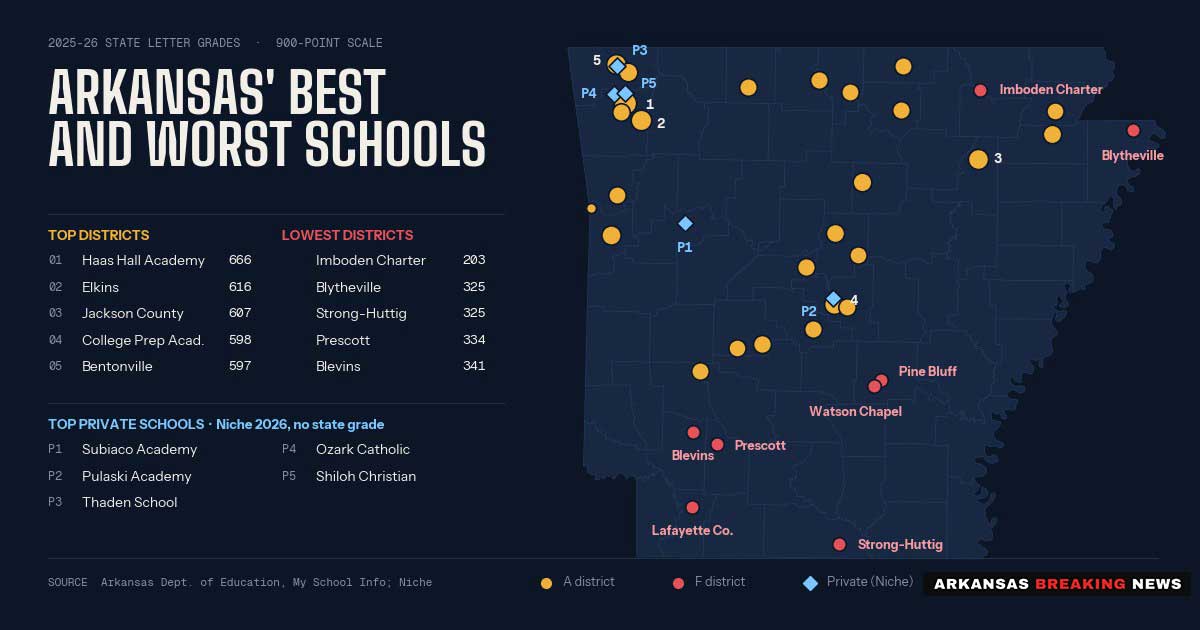
LITTLE ROCK, Ark. (ABN) — More Arkansas school districts earned top marks from the state this year than last, and fewer failed. But the improvement is uneven, and nearly half of the districts that received an F are in the southern half of the state.
The Arkansas Department of Education released 2025-26 letter grades for 258 districts and 1,047 schools on Thursday. Arkansas Breaking News pulled the full dataset from the state’s My School Info system to see who rose, who fell and what the grades actually measure.
The short version: 26 districts earned an A, up from the year before. Nine earned an F, down from 11. Of the 254 districts graded both years, 62 moved up at least one letter and 36 moved down. Median district scores rose 12 points on the state’s 900-point scale.
“At the end of the day, LEARNS is working,” Education Secretary Jacob Oliva told reporters, crediting the 2023 education law championed by Gov. Sarah Huckabee Sanders. Oliva said 7,800 students are attending a school this year that was rated D or F a year ago and now holds an A, B or C.
Scores are rising on the state test
The grades are built largely on the ATLAS exam, which the state adopted in 2024. Statewide proficiency has climbed each year since: math rose from 36.4% in 2024 to 44.2% in 2026, science from 35.6% to 44%, and English language arts from 33.8% to 39.5%. Across all subjects, 42.2% of students met the state’s target this spring, compared with 36.9% a year earlier.
That still means most Arkansas students are not performing at grade level, and independent measures are less encouraging. On the 2024 National Assessment of Educational Progress, the last federal comparison available, Arkansas fourth graders ranked about 49th in math and 43rd in reading, and fourth grade reading fell to a 21-year low. Researchers at the University of Arkansas Office for Education Policy noted at the time that Arkansas was trending down in eighth grade math and reading while neighboring states improved. The next NAEP results, from tests given this past winter, are not expected until 2027.
The OEP has also cautioned that a new state test makes year-to-year comparisons difficult, and that the first ATLAS results in 2024 looked broadly similar to proficiency rates Arkansas posted for years under earlier exams.
Who is at the top
Haas Hall Academy, the open-enrollment charter network in Northwest Arkansas, was the highest-scoring district at 666 points. Its Bentonville campus was the single highest-rated school in the state at 719, with 89% of students proficient in English and 94% in math. The statewide averages are 37% and 38%.
The rest of the top 10 districts: Elkins, 616; Jackson County, 607; College Preparatory Academies of Arkansas, 598; Bentonville, 597; Greenwood, 584; West Side of Cleburne County, 571; School for Advanced Studies-Northwest Arkansas, 569; Brookland, 564; and Greenbrier, 559.
Jackson County, a rural district around Tuckerman with a few hundred students, outscored every traditional district in Northwest Arkansas except Elkins. Tuckerman High School ranked fifth among all high schools, ahead of Bentonville High.
The remaining A districts were Alma, Benton, Centerpoint, Cotter, East End, Fayetteville, Greene County Tech, Harrison, the Institute for the Creative Arts, Lake Hamilton, Lakeside of Garland County, Melbourne, Norfork, Salem, ScholarMade Achievement Place and Vilonia.
Nine of the 26 are charter networks or districts in Benton, Washington or Sebastian counties. No district in the Southwest Arkansas Education Cooperative earned an A. Centerpoint, which serves Amity and Glenwood on the Clark-Pike county line, was the closest.
Who is at the bottom
The nine F districts were Lafayette County, Watson Chapel, Pine Bluff, Blevins, Prescott, Strong-Huttig, Blytheville, Arkansas Connections Academy and Imboden Charter.
Four are in the state’s southern tier. Lafayette County, Blevins and Prescott belong to the Southwest Arkansas co-op, and Strong-Huttig is in Union County. Blevins, Prescott and Strong-Huttig all held a C a year ago. Prescott’s 118-point drop, from 452 to 334, was the steepest among traditional districts.
Lafayette County, Watson Chapel, Pine Bluff and Blytheville each earned an F for the second straight year. Lafayette County was among six districts summoned before the State Board of Education last fall after the first round of district grades. Superintendent Jon Estes told the board then that the district had the lowest test scores in the state and that he was “ashamed and embarrassed” by them. At the time, 1% of Lafayette County High School students were proficient in math. This year it was 4.6%, and 7% in English. The school gained 93 points but remained an F. It graduated 95% of seniors on time, above the state average of 92%.
Three other districts called before the board last year, North Little Rock, Fordyce and Crossett, all climbed from an F to a C.
Pine Bluff spent five years under state control after a 2018 fiscal distress finding before regaining its local board in 2023. Watson Chapel has not been taken over. State board members toured campuses in both districts in February.
Blytheville posted the lowest graduation rate of any district at 69%. Five percent of Blytheville High students were proficient in math.
Arkansas Connections Academy, an online public school based in Bentonville with more than 2,700 students tested, fell from a D to an F. It is the largest F-rated district in the state by a wide margin, and one of five virtual programs rated F at the school level, along with Fort Smith Virtual Academy, Earle Virtual High School, Arkansas Virtual Academy Elementary and iSchool Virtual Academy.
Under the state’s accountability law, districts with the weakest results can be classified as needing Level 5 intensive support, which requires a state-approved improvement plan and can lead to the State Board removing a local board.
Cities mostly moved up
The state’s larger urban districts generally improved. North Little Rock rose from an F to a C, Pulaski County Special from a D to a C and West Memphis from a D to a C. Fort Smith, Jonesboro and El Dorado each climbed from a C to a B. Little Rock held at a C, gaining 14 points.
In the Texarkana region, Texarkana School District moved from a D to a C, though Arkansas Middle School remained an F and Harmony Academy of Music and the Arts earned its second straight F with 259 points, among the lowest in the state for a school its size. Genoa Central earned a B. Fouke, Ashdown, Hope, Magnolia and Hamburg earned Cs.
Not every mover went up. Poyen fell from 588 points to 491, and Prairie Grove and Valley Springs both slipped from an A to a B.
What the grades reward
The formula explains some of the surprises. Of the 900 possible points, 600 come from student growth, meaning whether students improved on their own prior scores, with extra weight on the lowest-performing quarter of students in each school. Only 300 points come from how many students are actually proficient. A district that earns 531 points, or 59%, gets an A.
That is why ScholarMade Achievement Place, a Little Rock charter, earned an A with 33% of students proficient in English and 22% in math. Its students grew faster than the state expected. It is also why Valley View in Jonesboro, which scored 549 points, more than 14 of the A districts, received a B: a district’s grade cannot exceed that of its lowest-rated school, and Valley View High School earned a B. The department’s own statewide summary initially listed Valley View as an A.
“If kids are learning, you’re going to get a good grade,” Oliva said.
April Reisma, president of the Arkansas Education Association, said a “rigid test-based A-F system” undermines the state’s claim of transparency when private schools that receive public money face no comparable accountability.
The private school question
That gap is growing. The department expects about 50,000 students to use an Educational Freedom Account this school year, the vouchers created under LEARNS. Private schools that accept the money are not graded, and account holders are not required to take the ATLAS. They may substitute a national norm-referenced test, and the results are not published school by school.
The most widely cited private rankings come from Niche, which relies on surveys, self-reported data and the colleges students consider. Its 2026 list of top private high schools in Arkansas: Subiaco Academy, Pulaski Academy, Thaden School in Bentonville, Ozark Catholic Academy, Shiloh Christian, Episcopal Collegiate, Union Christian Academy in Fort Smith, Little Rock Christian, Fayetteville Christian and West Side Christian in El Dorado. Trinity Christian School in Texarkana ranked 22nd.
Pulaski Academy, Niche’s top private K-12 school, charges $19,800 for its highest grade and reports that all of its graduates go on to four-year colleges. None of the schools on the list publishes proficiency rates comparable to the state’s.
What it means
For parents, the grades answer a narrower question than the letters suggest. An A signals a school where students are gaining ground on the state’s test, not necessarily one where most students are already proficient. National rankings measure the opposite. Private schools taking public money are measured by neither.
For the state, the trend line is real but young. ATLAS has been in place for three years, the grading formula was revised last year, and the next federal benchmark is more than a year away. Whether the gains hold, and whether they reach districts like Lafayette County and Prescott, will decide whether this year’s report card marks a turn or a blip.
Get the biggest Arkansas stories in your inbox
Breaking news, arrests and court updates from across the state. Free.
Confirmation email required. Powered by Mailchimp.