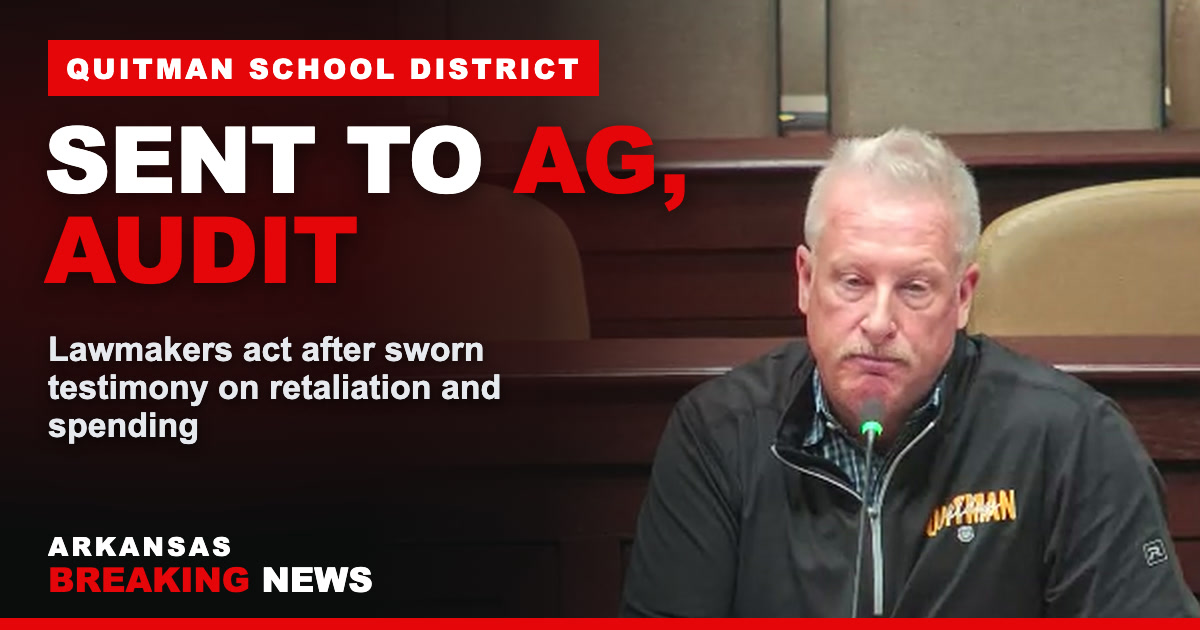
LITTLE ROCK, Ark. – A legislative committee voted Monday to ask the Arkansas attorney general’s office to investigate allegations of harassment and intimidation tied to the Quitman School District and its superintendent, and separately referred the Cleburne County district to Arkansas Legislative Audit.
Both motions passed on voice votes near the end of a more than two-hour hearing before the Joint Performance Review Committee, according to the Legislature’s video of the Oct. 19 meeting. Lawmakers heard sworn testimony from two child advocates, Superintendent Michael Stacks and Quitman School Board member Nathan Lindsey.
Rep. Rebecca Burkes moved to refer the matter to Legislative Audit “for further consideration.” Sen. Ricky Hill then moved to turn it over to the attorney general’s office for an investigation of “harassment, intimidation and any other charges they may think of,” according to the video. Both are committee members.
No one from the attorney general’s office spoke at the hearing, and the office had not announced any action as of Tuesday.
Who testified
The committee’s agenda listed the item as “Discussion of Allegations Pertaining to the Quitman School District.” The witnesses listed were Audie Alumbaugh and Melanie Fox, both identified as citizens; Stacks; School Board President Drew Varvil; and Lindsey. Varvil did not testify, according to the video.
Article continues below
▼ Continue reading
Alumbaugh told lawmakers she is a volunteer advocate for children with disabilities who works in commercial development in Conway and previously taught in public schools and at the University of Central Arkansas. She said she attends about 180 school meetings a year on behalf of families and is not paid for it. Fox said she is a former Little Rock School Board member. Neither lives in the Quitman district. Both said Quitman parents bring them complaints weekly but are afraid to speak publicly.
“I’ve never seen a district this toxic,” Alumbaugh said. “The message is really clear in the Q. Step out of line, roll the dice.”
Stacks, who became superintendent in July 2025 after serving as high school principal, athletic director and assistant superintendent, declined to make an opening statement. He told lawmakers most of what they had heard were “their versions of the facts” and that he disputed much of it.
“I believe that Miss Alumbaugh has a personal vendetta against me,” Stacks said. He said he did not believe she would stop until he was fired or lost his license, and that “90% of the noise, if not greater,” comes from the two women, who do not live in the district. He said the two had filed more than 400 public records requests with the district in four years.
Recalled to the table at the end of the hearing, Alumbaugh denied having a vendetta. She said she has known Stacks and his wife for decades and has advocated for members of his family. “There is a seed of truth in almost everything Mr. Stacks says,” she said. “But then it’s just elaborated to where it’s not accurate.”
The locker room case
Alumbaugh’s testimony centered on the district’s handling of abuse reported among seventh-grade football players in the spring of 2024, and on what she described as a pattern of retaliation against families who complained.
She told the committee boys were whipped with bullwhips, shot with BB and gel-ball guns and held down while other boys put their genitals against the victims’ faces. A father reported the abuse to the football coach on May 10, 2024, she said, but the district did not call the state child abuse hotline until May 15, after a mother came to the school demanding action. That report covered only one victim, contained incorrect information and was screened out, Alumbaugh said.
Stacks gave a different account. He said the coach got a call from a father on a Friday night, and the father called back after talking to his son to say the allegations were less serious than he had first described. The coach relayed the conversation to Stacks that night, Stacks said, but without graphic detail. The mother came to his office the next week with “much more dramatic and much more detailed” allegations, he said, and he made a hotline report that day. He said the coach acknowledged about a two-day reporting delay and that the state licensing board did not find him guilty of a delay.
Asked by Sen. Alan Clark what happened in the locker room, Stacks said that in addition to bullying, one or two students held another boy down and held his mouth open while a student said, “Now put your private part in.” Stacks said the boys “just said that” and let the victim up, that all of the students were clothed and that allegations that “rose to the level of rape” did not happen. Clark, who is not a committee member, pressed Stacks on when he first learned of the allegations. “I have never in 14 years had anybody more evasive who came here to tell the truth,” Clark said.
Alumbaugh later told the committee the mother did not return until the Wednesday after the father’s report, and that the school did not reach out to the other victims’ parents.
Stacks said the district paid the Mitchell Williams law firm $30,000 for a third-party investigation of the locker room and gave the report to the state Department of Education. He brought copies for the committee. Clark read from it: the investigator wrote that the district’s hotline report was rejected on May 16, 2024, that the conduct of one boy “rose to the level of sexual harassment” and was not “a one-off,” and that a video of another student on the ground was “heartbreaking.” “Nobody could watch that and not label it bullying at the very least,” the investigator wrote, according to Clark.
Stacks said four or five students were disciplined, with some removed from the team for a time and some moved to a separate locker room. He said the district set individual practice times so that victims, offenders and the 30 or 40 other players could all keep practicing under a juvenile court no-contact order, and that the order was enforced without favoring either side.
Alumbaugh said the boy the investigator identified as the main instigator played the entire football season and basketball afterward, and was placed on a year’s probation on assault, battery and harassment findings when his juvenile case was adjudicated the following January. She said the victims were the ones who lost practice time under the rotation, were told to shower last and had to choose between showering and eating breakfast. Most of them quit football, she said, and some left the district or are now homeschooled.
She also said Stacks emailed a parent that a Title IX investigation was underway, but that the district never completed one despite the sexual harassment finding. When a mother asked to address the school board, Alumbaugh said, she was denied, the school resource officer filed a police report about her visit that remains open, and she was told by the board that “if she did not like what was happening, she could go back to where she came from.”
Retaliation claims
After the parents told their story to the state Board of Education in September 2024, Alumbaugh said, Stacks sent a four-page document to the attorney general’s office and the education commissioner that contained “demonstrably false” statements about the juvenile cases, the victims and her. She said a juvenile judge released court records that contradicted it, and that the file’s metadata identified Stacks as the author.
Stacks told lawmakers the attorney general’s office had called the district about the locker room investigation and that the district contacted the commissioner after Alumbaugh spoke to the state board. He said the information the district provided lines up with the third-party report.
Alumbaugh said she presented the juvenile court records to the state board on Jan. 8, 2026, and that the next day Stacks filed a complaint against her with the Arkansas Ethics Commission. The complaint was dismissed, she said, and records requests showed Stacks had also filed an ethics complaint against state board member Jeff Wood, which was also dismissed.
She also said that while Marrs’ licensing appeal was pending before Cleburne County Circuit Judge Holly Meyer, Stacks texted a school board member asking whether she knew anyone who could reach out to the judge. Alumbaugh said the board member produced the messages from her personal email after her district email account was deleted, and that the same messages were missing from the district’s response to a records request. Stacks was not asked about the text messages.
Stacks and then-head football coach Danny Marrs sued two mothers and a community member after the parents spoke at the state board, Alumbaugh said. Fox said the defense cost the women about $80,000. “Nobody in the community would talk after that,” Fox said.
The special education family
Alumbaugh said one family that moved to Quitman to be closer to work has been through four special education due process proceedings since 2022, prevailing in the first two, settling the third and filing the fourth when the district failed to follow the settlement it wrote. She said the district has spent more than $300,000 fighting the family, reported the parents to the state Department of Human Services for neglect in a report that was dismissed, filed a police report over the address on their enrollment application and adopted a policy limiting who could attend the child’s education meetings. The family learned of the police report only when Stacks was deposed, she said.
She said the district also hired a private investigator to watch the family and their extended relatives, including people with no connection to the school. “A child with autism and his family were subjected to surveillance at taxpayers’ expense,” she said.
Under questioning from Rep. Mary Bentley, Stacks said the district’s law firm, Friday, Eldredge & Clark, hired the investigator with his approval after reports that the parent, whom the district pays to drive the child to a private school in Conway, was using Medicaid transportation instead. He said he saw what he believed was a Medicaid van himself while driving his bus route and mentioned it to the lawyers. Rep. Keith Brooks, who is not a committee member, asked whether hiring an investigator was common practice. “No, that’s not common practice for us,” Stacks said. He said the district paid the firm for the investigator’s bill but did not know all of the results, which he said are part of the family’s pending federal lawsuit.
Hill told Stacks that if he saw the van with his own eyes, “you should have jumped out there and done something about that yourself” instead of going to the law firm.
Clark later distributed a copy of what he described as the investigator’s invoice to the law firm. He said it showed eight hours billed at $125 an hour, with a note that the investigator had spoken with Stacks that morning and been told to send the bill “due to the lack of activity in this case.” Clark said that conflicted with Stacks’ testimony that he did not know what the investigator found and suggested the committee consider whether a prosecutor should look at possible perjury.
Alumbaugh said the child has never used Medicaid transportation and that the mother drives two round trips a day between Quitman and Conway. Stacks said the district offered to transport the child on a bus it already sends through the area and that the parent declined. He said the district now pays mileage for two round trips a day after losing a due process case over the agreement.
Stacks disputed the $300,000 figure. He said the district’s bookkeeper told him last week that Friday, Eldredge & Clark has been paid about $270,000 since 2023 for due process cases, the federal lawsuit and records requests, most of it tied to matters Alumbaugh was involved in, with part reimbursed by liability insurance. Alumbaugh responded that a different law firm handled the first due process case, so the Friday firm’s bills are “only half of the story.”
Stacks said his first dealings with Alumbaugh came in August 2022, when she came to his office as principal demanding the return of a student placed at the Arch Ford alternative learning campus. He refused, he said, and the family filed for due process. He said the student later threatened to shoot up the school, the district imposed handbook consequences and Alumbaugh took the district to due process again before the student changed schools.
Money questions
Fox told the committee that Quitman has promoted school choice through its athletic championships on social media and billboards. She quoted a Quitman football coach’s post: “Choice to the Q… If your school doesn’t have a choice plan, holler at me,” followed by a post about having “plenty of buses that drive to all the surrounding counties.” She said a post by the then-assistant superintendent, who is now the superintendent, celebrated 38 new athletes arriving through school choice.
She said that connection extends into taxpayer-funded jobs. According to Fox, one football player from the Guy-Perkins district who missed the school choice deadline enrolled using a gas station near the school as his address, then was put on the district payroll with no job application, contract or board approval in the minutes. She said payroll records show him paid from 8:30 a.m. to 5:30 p.m. on school days with no lunch break, and paid for a day he spent at a Little Rock court hearing in the former coach’s case. He graduated in 2024 and is still paid by the district, she said, earning more last school year than a custodian with 11 years in the district.
Fox said a second player from Greenbrier received more than $6,000 last school year, and a 2023 graduate stayed on the payroll until March 2025, when he was shifted to vendor status at $600 a week for grounds maintenance. She said that man received a $4,200 payment for “property services” on June 25 of this year, the week before he went on vacation with the superintendent, and that he and the first former player regularly travel with Stacks.
Asked by Sen. Mark Johnson whether he has taken students on out-of-state vacations, Stacks said he has not taken current students, “maybe graduated students who were friends of my children,” including two athletes on beach trips. He said the two former players on the payroll were summer workers hired with the board’s involvement and that the district has been told part-time workers do not need contracts.
Fox said Quitman spent $135 per student on substitute pay last school year, compared with $50 to $100 at similar-size districts. Of about 800 substitute days, she said, 552 were coded as “school business,” and 94% of those listed only a generic building account rather than a teacher. She said full-time employees have been paid through the substitute system, along with a volunteer coach and a board member’s wife who works as a dental assistant.
Alumbaugh said people associated with the district have collected school money through personal bank accounts and Cash App, and that payments to companies in which administrators or their spouses hold interests total more than $100,000. She said district records were incomplete and the group had to get figures from state agencies. Fox cited a board member’s sister-in-law paid over multiple years with no disclosed conflict, and the superintendent’s brother-in-law paid to pressure-wash school buildings.
Alumbaugh also said employees reported Stacks using his personal Sam’s Club account for district purchases including concession supplies, prom items, diapers and gift cards, and that the district told her it had no Sam’s Club account when she asked for records. Stacks said the district now has an account and that staff have long used their own Sam’s memberships while paying with the district credit card. “If I’m logged into mine on my phone and I’m scanning items, it is possible that I use mine, yes sir,” he said.
Bentley asked whether the district paid an athlete to attend a state board hearing for the coach. “No, ma’am, not that I’m aware of,” Stacks said. Alumbaugh later said records show a student was paid on July 7, 2025, to attend a court hearing in Marrs’ appeal.
Fox also testified that the board president said under oath in court that the board agreed in a closed executive session to pay legal fees for Stacks and Marrs in their licensing cases, without a public vote. She questioned whether an educator’s personal license is part of official duties. Stacks said he was not in that executive session. He said the district has paid roughly $70,000 for his and Marrs’ defense, which he said is part of his contract, and that the Friday firm’s $270,000 in bills were approved by the board.
On training, Fox said records raise questions about whether Stacks completed the state’s required novice superintendent training or made it up as instructed. She said a one-hour school finance presentation was credited to board members as four hours, that one board member signed in another who was not there, and that two current members are short of the six hours a year state law requires. The law requires the board to review hours each January and declare a vacancy if a member does not catch up within 30 days, she said, “and this has not happened for multiple years.”
Stacks said the finance allegations were new to him. He said the district had no findings in its most recent annual Legislative Audit review, had just moved $1 million to its building fund to keep its balance under the state cap, and that all board members have their required hours. “Our district is well managed,” he said. He acknowledged the high school and middle school have fallen from A grades two years ago to C’s.
“We have filed complaints with DESE, but who do you file complaints with on school board lack of training?” Fox asked. “Where does the public go when a district has broken multiple laws?”
A board member’s complaint
Lindsey, elected in March in one of the district’s few contested board races in years, said he ran because of the locker room case. He told lawmakers he has asked for monthly financial reconciliation reports for months without receiving them, that hiring documents given to the board have been redacted or missing, that a member of the public got more through a records request than he did as a board member, and that board minutes misstated a vote. He said the district uses two law firms and he has struggled to learn which is handling what.
“You cannot govern what you’re not allowed to know,” Lindsey said. “Asking questions is not insubordination. Requesting documents is not obstruction.”
He said a board member related to a candidate for high school principal took part in that hiring, including seconding the motion, without the recusal and education commissioner’s approval he understood to be required. When he warned the district could be left without a principal, Lindsey said, Stacks called it “a risk he was willing to take.” Two weeks before school started, he said, the board was given one option: hire the boys basketball coach, who had received his administrator’s license weeks earlier, as an intern principal. On the second day of school, Lindsey said, that intern principal was the only administrator on campus while Stacks was at a deposition and the other principals were at a state board meeting.
Lindsey also said an opponent was allowed to put campaign signs on school property, and that he has text messages he believes raise questions about whether Stacks worked against his candidacy. He offered them to the committee. He said that when he forwarded a constituent’s report of an incident at the elementary school, the response focused on the constituent not going through the chain of command.
Stacks told the committee Lindsey has voted with the majority on 85 of 87 votes, and that both no votes concerned rehiring a longtime high school principal whose brother-in-law sits on the board. “If there were concerns around that because her brother-in-law is on the board, that goes off into a whole other issue,” Stacks said. He said Lindsey is a friend of Alumbaugh’s.
Sen. Dan Sullivan asked Lindsey whether he had filed a formal records request for the bank reconciliations he wants. Lindsey said he had not. The committee’s chairman said a board member should not have to file a records request with his own district. “If I was a school board member and I asked for financials and I can’t get them, I’d be asking for somebody’s job,” he said.
Lindsey confirmed to Hill that Marrs is no longer employed by the district. Alumbaugh, who said she livestreams Quitman board meetings because parents are afraid to attend, told Sen. Joshua Bryant the board renewed Stacks’ contract just before the March election and recorded the vote as unanimous although one member did not vote. She said the board recently approved $222,000 for a gymnasium scoreboard rather than spending on compliance with Eli’s Law, the 2025 locker room recording law that Brooks sponsored in response to the Quitman case.
Rep. Alyssa Brown disputed Stacks’ claim that most criticism comes from outside the district, saying she has heard from Quitman families, including boys who now attend school elsewhere. “There are real victims in this case,” Brown said. “Mister Stacks is not one of them.”
Sullivan told the advocates that “the accountability rests with the voter” and urged residents to file complaints locally so lawmakers have a record to act on. Sen. Ricky Hill asked why the two women were testifying instead of the parents. “The arm of the retaliation is so strong,” Alumbaugh answered.
Licensing cases
Both Stacks and Marrs have been disciplined by the state Board of Education over the locker room case, based on ethics complaints Alumbaugh and Fox filed with the Professional Licensure Standards Board in November 2024.
An ethics hearing subcommittee found Stacks violated the educator code of ethics and recommended three months’ probation, according to a transcript of the state board’s Aug. 1, 2025, meeting. The state board, which had pulled the case from its consent agenda in July, voted 4-2 that day to impose two years’ probation, required training and a $250 fine. Stacks told lawmakers Monday the violation involved failing to tell one parent the results of a bullying investigation, which he said he had assumed the dean of students had done. “That was my fault,” he said. He said he is paying for his appeal personally, and that he believes the state board moved its meeting up to avoid a new law limiting its power to pull licensing cases from the consent agenda. The case remains open in Pulaski County Circuit Court, court records show.
Alumbaugh said the 11-hour hearing was lopsided: nearly half of the documents she submitted were left out of the packet, her side was limited to one witness while the department called all of Stacks’ witnesses, and one of the adjudicators had studied at UCA alongside Stacks’ wife without disclosing it. Stacks said he answered questions for 11 hours at that hearing and took ownership of the violation.
The state board suspended Marrs’ license for one year in June 2025. Cleburne County Circuit Judge Holly Meyer vacated that decision Jan. 6, 2026, finding that board members Jeff Wood and Leigh Keener had improper off-the-record communications with Fox and Alumbaugh while the case was pending, according to the judge’s order. Stacks told the committee the court “found Ms. Fox and Ms. Alumbaugh guilty of ex parte communications,” which drew head shakes from the two women. The order itself said the duty to avoid those contacts falls on board members, not members of the public. Lawyers for the state board filed a notice of appeal in February, court records show.
On remand, the state board, without Wood and Keener, voted 4-1 on March 12 to again suspend Marrs’ license for one year followed by two years’ probation, according to the meeting transcript. Marrs is no longer Quitman’s head coach; the district announced a new head coach Jan. 6.
The lawsuits
Stacks and Marrs filed their defamation suit against three women in Cleburne County Circuit Court on Oct. 10, 2024, court records show. The suit also claimed civil conspiracy, harassment and interference with their jobs.
After an April 2, 2025, hearing, Meyer dismissed the conspiracy and interference claims for failure to state a claim, and the plaintiffs dropped the harassment claim, according to her written order. On the defamation claim, Meyer found the complaint lacked the sworn verification Arkansas’ anti-SLAPP law requires and ordered Stacks, Marrs and their lawyer to file it within 24 hours. The next day, Stacks and Marrs moved to dismiss the case without prejudice, saying additional defamatory statements had come to light and would be included in a new complaint. Meyer granted the dismissal April 21, 2025. A search of state court records Tuesday found no new suit by Stacks and Marrs against the women.
“In my opinion, this is a classic example of a SLAPP lawsuit,” Alumbaugh told the committee, “intended to intimidate and silence the people who are speaking out.”
A separate lawsuit filed in August 2025 by a district taxpayer accuses the district of illegally spending public money on Stacks’ and Marrs’ legal fees, court records show. The suit says the district paid Friday, Eldredge & Clark $71,058.26 in March 2026 for that work. Meyer denied a preliminary injunction in January, ruling state law allows districts to pay to defend employees in proceedings arising from their official duties, but she found the board never formally voted to hire counsel for the ethics cases. Cross-motions for summary judgment are pending.
Special education rulings
State special education hearing officers ruled against the district in at least three due process cases in 2023 and 2024, according to decisions the Arkansas Department of Education publishes. In an April 2023 decision, a hearing officer found the district denied a student with autism a free appropriate public education after repeatedly unenrolling him over residency and providing less than half the therapy minutes his plan required. A May 2024 decision found the district denied a student that education by withholding records from his parents, though it rejected several of the parents’ requests, including barring Stacks from future meetings. A June 2024 decision in a different student’s case reached the same conclusion.
Alumbaugh told the committee the family was homeless under federal law at the time because their house was being sold, and that the district kept unenrolling the children even after the Education Department sent a letter saying they had to be enrolled. Stacks said a hearing officer found the district denied the student a free appropriate public education over “maybe not providing enough speech minutes,” and questioned the idea of winners and losers in due process. “It’s about a child that didn’t receive what they need,” he said.
Alumbaugh said a complaint the parents filed with the department’s Compliance Assistance Center resulted in findings in their favor, and that records requests turned up earlier compliance complaints dating to 2021 with state guidance the district did not follow. “Could some of that abuse in the locker room have been prevented had anyone from the Department of Education followed up?” she asked.
Stacks told lawmakers a federal lawsuit by one of the families is still pending, that depositions have been taken from him, the former superintendent and the district’s special education coordinator, and that the district’s lawyers have moved to dismiss it.
What’s next
Asked by Hill what she wanted from the hearing, Alumbaugh said the group was looking for a referral to Legislative Audit or the attorney general’s office. “We have stacks of evidence,” she said. “I don’t know where to go from here to make sure that justice is served.”
Sen. Mark Johnson, a Legislative Audit member who is not on the performance review committee, said during the hearing he would seek an audit referral from that side if the committee did not act. The chairman reminded witnesses that the testimony was sworn, livestreamed and recorded, and “can go different places.” The committee plans to meet again before Dec. 1, the chairman said.
Get the biggest Arkansas stories in your inbox
Breaking news, arrests and court updates from across the state. Free.
Confirmation email required. Powered by Mailchimp.



1 comment
Join to comment.
Members only
Comments are for members
Members can comment on every story and reply to each other. Join at any level, from $5 a month.
Become a member Already a member? Sign in